
Frankenride

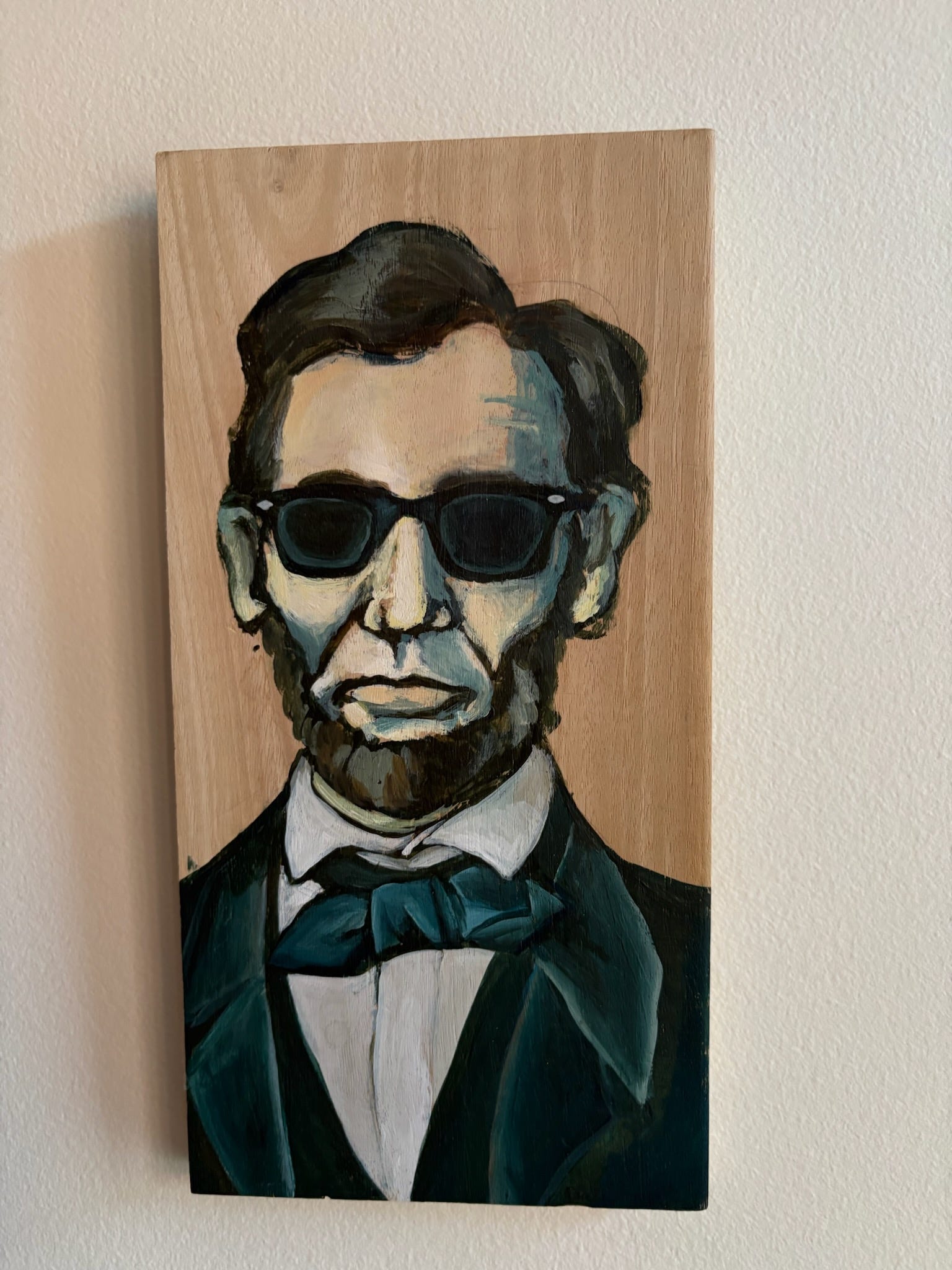
Artwork by Julie Clinkingbeard
FRANKENRIDE
1. Hagerstown
Hear me, America! Or what the heck, just feign half-assed interest until my Beltway monicker adds a banana-peel caption to my apple-pale kisser. The one compulsive travelers and you stay-at-homes alike saw guilloteamed long ago on the competing covers of the country’s two leading newsweeklies, not to mention the National Enquirer, Ms., Mad in Mort Drucker caricature, the Frankfurter Allgemeine Zeitung -- maybe someday I’ll find out what they had against me – and, long story, OdysseUS: The Peace Corps Alumni Monthly.
Yes: old now, I’m he. To this day, decades and change after Genya Doolittle Grimm’s disappearance and murder (you may have forgotten they did find what was left of my Geenie long after I was out of the news), I’m still hailed as Frodo Harbinger when I perambulate around the Quarter’s indigo a-go-go evening light and strikingly vintage urban dental work aboard the bike I’ve nicknamed Ah-Nold Schwinnzenegger. Sometimes accused of being Frodo Harbinger comes closer to the truth; the case has never been solved to anyone’s satisfaction.
In some of you unwitting nostalgists’ eyes, I’ll be under suspicion until I’m a handful of dust. What happens to me after that is as irrelevant as the Twin Peaks reboot. I’m nobody already, just the visiting Leif Raleigh Bonaventure Professor of Politics at the risibly and hence accurately named New Orleans School of Government. Let no one accuse our cryptic Board of Governors of false advertising! If they prefer anonymity, which they famously do, I can’t say as I blame them.
In our age nothing goes without saying, so my hope this does is forlorn. The clownish name Frodo Harbinger never appeared in any campaign literature or television ad of mine. It did appear in The Congressional Record in October, 1991, but only because the Senate Ethics Committee was going piranha on my apple-pale keester. That’s when the derisive handle bestowed on me early in my Senate days by the late GOP operative and George H,W, Bush enabler Lee Atwater – of whom more later, as novelists more prim than I would say -- went what you’d now call viral thanks to Geenie’s misfortunate diary,
Few people knew Harbinger wasn’t my birth name, but few people knew Hart wasn’t Gary Hartpence’s either until my onetime Senate colleague (D-CO) mapped my future sled-zoom down Capitol Hill’s sex-scandal toboggan. I was born Craig McBride in a state whose most celebrated folk figure is the kidnapped and murdered, not by the same people, 19th-century white woman who’s only known to O-D schoolchildren as The Bride of Hollow Sky. Feel free to get busy with goose pimples.
In her case, ancestry.com is clearly no help in determining whether we are or were blood relatives. Even if The Bride was my ancestor, and why not?, it’ll be much too late to affect any vote tallies back home. (Up or down? Beats me, Lee. I’m not as smart about that kind of thing anymore as you were.) I was Craig or Craig Morris Harbinger in every race, from my 1974 bow as Boy Mayor of Wyandotte and my two terms in the House to my summit as United States Senator Craig M. Harbinger, R-OD.
Yes, I’m a Republican. What of it? The actress Geena Davis is in Mensa, and nobody ever gets on her case about life’s little incongruities. Yet if to be American is most succinctly definable as not knowing what you had until it’s gone, no one’s more American than me.
It’s my strange – that is, echt-American -- boast that despite having to resign my Senate seat under threat of expulsion and still often insultingly hearing myself termed a murderer who got away with it, I’ve never lost an election. I was recently voted by the mockery-prone student body as the New Orleans School of Government’s least unpopular prof; perhaps a comeback’s in the offing? I just didn’t know how lucky I was to be a Senate nullity until Geenie Grimm (1967-1991) disappeared.
Out of nowhere, I was black, white, and electrocuted: my scandal-skewered mouth askew, my eyes skittering like two nudes descending a staircase on ice. That was 1991 journalism’s simulacrum of a perp walk, Warholized on airport newsstands from Cape Codpiece – hi, Ted! – to newly anchorite Anchorage. In vain did I, do I still!, protest that I was never arrested. Jesus of Nazareth can’t make that claim, although my fleeting Burbank Airport acquaintance Richard Nixon can.
Nor was I ever indicted, sentenced, Count of Monte Criscoed, ouch!, shipped to Gilligan’s Devil’s Island, or even successfully sued after Geenie turned up missing the night of August 6-7, 1991, from her disconcertingly pastel sublet – it was temporary, she said, and how right she was -- on Columbia Road in Adams Morgan. Despite or because of (I’m no sexist, despite what they say) the presence on her low-slung bookcase of a plainly much cherished book for young readers called Lassie, Lassie, Fly Away Now, which I didn’t yet know was a YM biography of Amelia Earhart, “girly” would have been the mot juste for its bedroom’s décor.
Heck, just ask The World of Henry Orient’s glorious Tippy Walker. Everybody’s dashed hope of future kingdoms by the sea, she’s still revered by grizzled, crazy, gravy-stained geezers like me as that movie’s immortal portal to adulthood.
∞
Before Hagerstown, Geenie was just (ok, almost just) the fetching new gal who’d come on staff recently at the Senate Governmental Affairs Committee. Its strikingly odorless everyday potpourri combined and probably still does combine earnest aspiring lawyers in 310 Dirksen and Senators annoyed they didn’t get showier committee assignments. How often do you see a Government Affairs hearing on TV? A 23-year-old towheaded sylph with legs like a very lean long-distance runner’s was bound to get herself noticed.
That was especially true if she seemed to suspect earnestness wasn’t all there was to life and had guessed – rightly so, we’d soon fall all over ourselves to assure her-- that silly, adorable gifted children often for pure safety’s sake hide inside cranky middle-aged men so convinced they have better things to do that tabulating them’s gotten too dicey to contemplate. I’d made this one laugh a few times when she found reasons to visit my office in the Russell Office Building, hailing her tacit resourcefulness by progressing way sooner than usual from “Hi, Gen– uh, it’s Geenie, isn’t it?” to “Hi, Geenie!”
As far as the nonexistent stenographer taking down her every word was concerned, Geenie’s “Hello, Senator” stayed unaltered. But her smile went from generically sunny to bespoke mischievous. Around then, on the off chance I was stupid (she didn’t really know me all that well yet), she added an exclamation point.
As for me, I took care to show I wasn’t as ungrateful as all sorts of imaginary men in my shoes would be by making sure to have shop-talk quips handy just in case she showed up. Fresh ones, too, tailored to Governmental Affairs – and was that ever a first, brother. Nobody on the committee had made an original joke since Teapot Dome, and its originality was only hearsay among the Senate side of the Hill’s most doddering doormen. We had no way of being positive “Counsel, you made the complaints too long” hadn’t been stolen from burlesque.
Something you have to understand about the tender way these unequal affairs begin is an overlooked perk, not to say alibi, built into being the Senator in the scenario. They invent the reasons to futz around looking pretty and holding unimportant papers; you don’t. You don’t have to unless you’re one needy soul, an unfailing sign voters picked the wrong guy,
That sign’s most often taken down after the next election, and never by soon-to-be-former Senator Insecure’s choice. Paul Trooncate, for instance (R-Uthere, filling out expired Aaron “Ayrie” Corona’s unexpired term) came and went in ’83 without giving anybody but Dole a reason to recall he’d been here, there, or anywhere.
Still in my first term then, I liked Paul. That was partly because I made a point not only of being genial to nonentities but devising opinions of them to stay on my toes. That’s just good politics, people. Another reason I liked him was that the poor nebbish had absolutely no choice but to like me, and a change is as good as a holiday.
Not only did Trooncate the misplaced plastic surgeon, who’d flattered himself that becoming the state’s most gullible Republican superdonor hinted he knew a hardball little thing or two about politics, opt out of even thinking of standing for election in his own right in Uthere in 1984. From my perspective, that was just sanity at work. The Great Lakes region couldn’t keep counting forever on my uncertainty about where one state led to another and why to keep its nebulousness intact as far as I was concerned.
On the other hand, so far as I know, and I would – we all would, because Senators-only elevators have ears too – the little nut never even got laid before he fled back to Stirringchoke, UH, with his Senate tale between his otherwise twain-shall-never-meet little legs. If he’d been hoping for pointers in Senatorial satyriasis from me, I couldn’t help it that he was too short to make corridor walk-and-talk confabs practical.
I certainly wasn’t going to invite him into my inner sanctum at the end of the photograph-tiled corridor (me with Reagan, me with Thatcher and Jean Kirkpatrick, David Hasselhoff and me, tam-o’-shantered S.I. Hayakawa ((R-CA)) with us) in Russell 286. My private office really was for Senators only, not wannabes with sickly grins who couldn’t get anyone else’s attention off the Senate floor, let alone on it, without jumping up and down in faux-Chippewa elevator moccasins.
Pyrite of Kiwanis
And then, one day, Geenie popped in on urgent Governmental Affairs business wearing a new hairdo. I idly asked her if she’d like to tag along with me to Gettysburg that evening to make the trip less dull. Especially in a state whose votes I’d never need to solicit – I’d given up on the Vice Presidency long before then, believe you me, albeit not exactly by choice -- addressing the local Kiwanis Club on the subject of Abraham Lincoln’s not precisely vague association with the place was a chore so routine the man himself could have probably mustered a few groggy but cogent remarks on the topic right after Booth shot him.
Just a day trip, Geenie, I said, holding up a palm so virtuous it could have modeled for one of the Virgin Mary’s hands. But you must have much better things to do on a Friday night, I added, feigning a puckish bowdlerization of my secretly real regret.
Holding up Christ’s mother’s other hand – the one that, in Michaelangelo’s Pieta, seems poised to test her dead boy’s reflexes by cracking him smartly across the kneecap – Geenie said she didn’t and she really wouldn’t mind, all (unspecified) things considered. From that, I think, I was to deduce that she had an unspecified boyfriend but they might be having a spat.
∞
The misstatements, magic-trick misdirections and flat-out fibs in the foregoing bland description could choke Roy Cohn’s ghost, already apoplectic with rage at the world’s mendacity (“Roy, you’ll never die,” an appalled but chuckling, dentally pipe-flagged Murray Kempton told him once), into a far more choleric because somehow customized and therefore more menacing fury. Let’s take them roughly in order, viz.:
Did I say my question was idle? Indeed I did, and that’s the true part. Every man knows how lust can lay idle, motorvating motionlessly and all but noiselessly away like a cabin cruiser patiently ticking over at life’s dock for visiting royalty. (Insert pic of Princess Margaret looking hubbalicious here,) Sometimes they’ll show up soon if we’re lucky, but a cold wind‘s stirring on the lake anyhow.
Speaking of cold winds, it wasn’t just “one day,” It was April 12, 1991, the chilling 89th anniversary of the Titanic’s icy sinking. If you think I had that information at my fingertips, however, I did not.
Could I therefore claim ignorance of the fact? I couldn’t. My longtime administrative assistant, Monica Heide, understandably dreaded overburdening her boss’s daily information plate. But she suspected, often rightly, I could use mute prompts reminding me of calendrical associations random people might bring up in conversation. That Friday, she’d decorated the door-facing hindquarters of her massive (1991, people!) desk computer with a child’s drawing of a nameless ship jackknifing into an ocean’s blue Smilie buttons, augmented by a balloon speech pasted on in a different hue of construction paper and in Monica’s own hand: “I thought you brought the lifeboats.”
Complicating things unnecessarily by any yardstick save my memory’s greedy clutching after Geenie-scented straws, the preceding paragraph of corrections to my description could use annotating itself. 1) Another fib was implicit in Monica’s pretense that her ambulatory collection only served to amuse tourists and home-state visitors. On the Hill, feel free to say they’re six of one only if you ‘re a little in love with death, as Eugene O’Neill’s stand-in claims to be in Long Day’s Journey Into Night. Her mementoes were as much For My Eyes Only as if I’d viewed them under a cone of silence at Langley.
2) A fib within the fib was that Monica had a limitless supply of nieces, nephews, and old family friends’ children whose promising early artistic work she’d deemed worthy of decidual transplantation from suburban kitchens’ provincial Musḗes du Frigo Au Truc Magnetique. Unnamed, unseen, and odds were nonexistent, those tykes would have meant less than nothing to her even if they’d been real. The only bumbling but talented, precocious kid she cared about or for was me. I had terrifying images of her sitting on a stale rug nights amid gluepots, string, construction paper, stubby scissors and a set of watercolors as abused as a Saturday FBI fingerprint pad to manufacture her desk’s sentimental ornaments her own self.
3) The true sentimental ornament providing a plinth for the fibs within the fib was the desk. Or rather, its assertion that Monica was R-286’s queen-bee receptionist, confusing people introduced to her as Senator Harbinger’s puissant administrative assistant, aka chief of staff in Capitol Hill-ese.
Worried the title might spell hubris in mere legislators no more entitled to grandeur than their 536 colleagues, my branch of government had solved the problem by giving the same job a different title. Monica’s reception-room assertion that she was also, nonetheless, and primarily my secretary was a unique twist recalling our professional relationship’s origins, for she’d been my first hire as Boy Mayor of Wyandotte in that capacity and that capacity only.
4) Prior to that, Miss Heide been my ninth-grade English teacher, steadfastly championing my adolescent ambitions to write the ultimate novel about our often overlooked home state. But I suspect there’s only so much back story the traffic can bear at this point.
5) If I didn’t get Geenie’s name right immediately, blame the way she introduced herself as Monica Heide looked on. “Senator? I’m Genya Grimm, your new Governmental Affairs liaison.”
∞
To resume, to resume, O spare me this spume. Save only a hypothetical office wastebasket fire threatening the aimlessly serene beauty of a Dirksen 310 Pizza Friday – yes, it had happened once or twice – nothing Governmental Affairs was embroiled in could be labeled urgent. While it’s hard for me to recall, because I don’t care and she didn’t either, I believe the sheaf of papers Geenie had astutely recognized could not wait until Monday made a lead-pipe-cinch case against trusting a whistleblower at the Coast Guard School For Bosuns in Providence, RI.
Calling her hairdo new elided that it was so old-school she’d had to talk her hairdresser at Follicle Foxes in Adams Morgan into trying a cut so radically at odds with prevailing Senate-staffer fashion. It called the superficially disorganized free-for-all forward romp of her rebel pompadour’s rakehell pale citron-yellow tumble to sleepless temporary assembly on her tall forehead’s parade ground, as I recall, while leaving the nape of her neck as erotically nude as a boot camp’s best pupil’s. Its former popularity dated to the cusp of the Jazz Age and the Great Depression, around when Amelia Earhart began flying in earnest. As bragged up in barbershop-quartet typeface by the illustration of various bold vintage women’s hairstyles an amused (always) Geenie dug up for my later inspection, it had been known back then as the Cyclone.
Sunset on April 12, 1991, was at 7:31 p.m. Even if Geenie hadn’t said she needed to dash home first to change – which she did say, but she was still wearing her office clothes when I picked her up at 7:07 – the plausibility of this being a day trip was on the Titanic-joyously-steaming-into-New York Harbor side. “Day trip, Senator?” an amused (already; drollness never wholly deserted her until the night she was murdered) Geenie asked.
“Well, tendentiously, yes. I’m scheduled to speak at 8 p.m., so we should be back inside the Beltway well before witching hour.”
“Don’t you mean could?”
That was the sauciest she’d ever been, and we were within earshot of Monica too. Monica was coming with us, though. It wasn’t until the next morning, when I hefted Geenie’s handbag outside the Hagerstown Econolodge whose hospital-for-traumatized-carpets interior was never seen by my now MIA longtime receptionist-cum-AA, that I realized it had enough aspirations to satchel status to hold the Adastra sneakers she always changed out of and then back into on her workday commutes, a Monet-blue pair of Levi’s, a Minor Threat T-shirt for bedtime and/or Saturday wear, a hairbrush (even Cyclones need discipline), a toothbrush, toothpaste, two shades of lipstick, and a triad of lambskin Trojans. That was what she’d had to dash home for, and the fourth time we had sex, we decided to throw caution to the winds and fuck bareback.
∞
My first sight of Geenie’s Adams-Morgan bedroom on Saturday was almost my last. Lord knows it should have been if I valued my future and -- suddenly, belatedly, out of nowhere – hers in the District. All but unmanned by her cramped cubby’s somehow accusatory girliness, I was four-fifths convinced it would be.
Divided into quadrants by a leaded window whose Revolutionary War aspirations to God-compartmentalized riot and resurgence reminded me lunatically of Boston’s Old North Church, Columbia Road looked ready for surgery, as roads will on spring days when they’re still in denial, however preposterously, about being urban. The Aprilesque sky’s feathered blue and gray, touch the panes!, chill turned the Rothko-ish puce, vermillion, and lilac of Geenie’s own down comforter into an invite to two-spooned Baskin-Robbins and a snuggling but sexless Mary Tyler Moore rerun, not the carnivalesque veni-vidi-Vadim rogering I’d innocently imagined would outdo our first-second-third-fourth Econolodge trysts.
Those were still as fresh in my memory as newly baked bread. Hand-kneaded as witching hour took over from the wee hours’ graveyard shift, then paused this morning on the road home from Gettysburg. Who doesn’t love the smell of fresh-baked foodstuffs at dawn on an old battlefield? It’s the smell of Viceroys, a long defunct cigarette brand once unaccountably popular in my home state. One thing about being my age is that even if you haven’t smoked tobacco since your gag-man childhood, you’ll remember that odor whenever it wafts through memory’s door.
Little did I know that the world or anyhow these United States would both note and remember what we said and did there. Not for long, but still. It didn’t happen in Gettysburg, though. It happened in Hagerstown, our improvised – yeah, right – pit stop for the night after Senator Craig Morris Harbinger (R-OD)’s none too memorable, I hoped, address on the occasion, sort of, of Abraham Lincoln’s death a not exactly totemic 126 years previous.
Nonetheless, I thought at first my “remarks” (that’s how they were billed on the otherwise excitement-denuded program) had gone over well. Gone over well with Geenie, my only measure worth eyeing unless Monica counted. That was because, save only the two of them, I knew or thought I knew I’d never see any of these horse-and-bughouse P-A jokers – to outsiders, even Pennsylvanians who aren’t Amish have a way of behaving as if they mysteriously failed the test to become one – ever again.
“I know you have to get on, Senator, so I won’t detain you. But you’ll have to come back in June for the blueberry festival. Man, big crowds then,” the Gettysburg Kiwanis Club’s overweight secretary told me as we up-and-downed farewell hands. He seemed unusually overwrought for one of these speaking-part bit players in my life, as if I was famous to him in a way I hadn’t been before my remarks on Abraham Lincoln and certainly wasn’t to anyone in Pennsylvania outside this room. I might be a U.S. Senator, but it wasn’t as if I was Jim Rockford, Wilford Brimley or anyone else with genuine star wattage hereabouts.
Knowing the rules, we were both too intent on feigning continued interest in our fleetingly lifelong friendship to indulge in more than a cursory gander at the ringleted but incongruously non-Anglo, was she a Latina?, hired re-enactor whose hoop skirts were glumly wedding-caking exitwards. Dragooned into Gone With The Wind on the wrong side of the breeze, she’d gotten fed up with hanging flouncelessly around to no purpose. My interlocutor was plainly just as depressed by the turnout as she was, and I couldn’t blame him. I’ve seen outbreaks of mumps with more gumption.
“Don’t you mean bluebelly?” I teased Senatorially, hoping to cheer the guy up. I couldn’t do much about the way his overwhelmed belt was gasping for air or his, here came the mumps again!, persimmon and Pyrite-spectacled face.
“Oh, no. That’s in July,” he gasped, delighted and grinning and grateful. “But you’ll be welcome at both of them. You especially, miss.”
“It’s a date. Maybe I’ll come alone if he’s busy!” Geenie said it so nicely: as if his courtesy in the midst of agitation was important to her, and maybe it was. And she’d had no training, none at all. What a good politician’s wife she’d have made!
(If only she had, if only. If only we. Genya. Geenie Grimm Harbinger. But in my arms, except once, she was always Gigi.)
Meanwhile, her Pyrite-undisfigured eyes, which were a lovely shade of hazel and quite nude, were smuggling a contraband question my way. Did we – she and I, I and she, me and her, an embryonic and hence easily aborted new us – have a date? At any rate, she seemed to want to get me the hell out of here as much as Pyrite of Kiwanis did. I couldn’t see why; the ungluing and defrosted frieze of attendees seemed unusually fascinated with pausing to gogglingly take me in.
As if to forestall, contradict, deny or just replace those flattering but puzzling gazes – usually, people who looked at me like that wanted to talk to me, too -- Geenie’s almost pleading eyes changed their emphasis. Did we have a date? Could it start now? And more vitally, would it exclude Civil War battlefields and rubbernecking Kiwanis onlookers?
All the same, in my memory, though perhaps only weirdly colander-filtered reality, her profile, now uneclipsably posing for John Singer Sargent’s expertly vague brush as she pivoted to take in the dark-clouded lobby door, seemed to presciently signal that we’d better visit a theater or perhaps an all-night (convenience comes in all forms) art gallery first as a respite from Kiwanis or possibly just breather; this despite the former’s dangers as a precedent with our 16th President so ectomorphically near. She seemed convinced we could use a couple of hours around people but not with people before we could be truly alone – that is, together.
∞
As I told D.C.’s Metro Police in August and will repeat to you, that very real theater visit – all of an hour away as of “It’s a date,” as the Kiwanis birds flew – was Geenie’s inspiration. Even on a Friday night, as I also told the cops, there just isn’t a hell of a lot going on in Hagerstown. The pure oddity of a pathetic local production of a famed Broadway musical whose noncurtain went up at 9:45 p.m. – 9:45, really? Why the by-appointment-only precision? – somehow crystallized the place’s futile struggle against life’s unsleepingly encroaching pointlessness. The duel was under suspicion of being more acute there than in Greenwich Village or hell, South Philly.
As I was hoping, my jibe at Hagerstown’s lack of a discernible motive for being anything at all except convenient – and to what, nobody knows -- got me a respite. One peculiarity of Washington is that, despite being the North Pole of the Free World, or whatever we were the week of my first grilling, the District doesn’t get to bully many other places socially.
Lording it over one’s own suburbs smacks of desperation, and besides, it wouldn’t work. Too many of the people hunting for a coat-hook to hang their superiority on live in Falls Church or Annandale or Old Town Alexandria themselves. Or even relatively remote Manassas, whose only certificate of suburban status is that it had been close enough to Washington for picnickers to ride out there and enjoy their ringside seats at the Civil War’s first pitched battle.
Close enough by carriage, mind. Cars hadn’t been invented. “If Henry Ford had only gotten on the case a little more P.D.Q., the Civil War would never have happened,” the unshaven bicycle-tour maven who calls himself R. Mutt Hasbro told me last week at Molly B’s on The Market, my New Orleans friends’ favorite bar in the Quarter.
One of them. They’re all our favorites, depending on proximity (a Nola priority) and mood (also a Nola priority). The only stricture, casually violated as often as not, is to shun Bourbon Street, because Bourbon Street’s a cliché by tourist standards. My own regularly irregular visits to the titty dancer who calls herself Pippi Sheerstockings, a longtime minor attraction at Right Twice A Day between Bienville and Iberville – in real life, Jo’s a grandmother – occur outside my pals’ knowledge, and probably their interest.
Locals prefer the sidebar funk of places that are only clichés by Quarter or Marigny standards, an important distinction here. Looking for a place that isn’t a cliché at all just proves you’re a hopeless New Orleans newbie, because all the best people gave up on that fool’s errand decades ago. Mutt’s one of the transplanted experts who steered me straight on that when I first moved here, and it’s no wonder Spokes Persons, his bike-tour company, keeps inching its way upward in the TripAdvisor rankings.
In New Orleans, you also call bullshit on people like R. Mutt Hasbro at your peril. His bullshit is volitional and the portal of discovery. That’s why I love to fake-call bullshit on him; I’m rewarded with a gem every time.
“Okay, Mutt. Why would the internal-combustion engine’s timely arrival have prevented the War Between The States, with all its expense of blood and treasure and general bad feeling?”
He looked openly contemptuous of my stupidity, an intimacy Mutt only indulges with his closest friends. I’m always warmed.
“Oh. By then, we’d all have already known each other too well, that’s all. For a drunk who used to be a Senator, you can be a real fuckin’ cretin, Frodo.”
∞
In terms of the District’s always shaky need to feel bien-pensant about itself, places it can safely cock a snoot at are the reason the nether parts of Maryland – that is, those beyond suburban status, but too much in limbo for even promiscuous Baltimore to claim sloppy seconds – were invented. Because police interrogation rooms have a kinship with locker rooms, just as precinct headquarters overall match the atmosphere of gym facilities in general, my respite took shape as muttered oh-shit-yeahs, soft chuckles. Then came those beefy men’s ultimate backslap.
“When you’re right, you’re right.” That cop spread his polyester-chafed thighs wide and luxuriantly clawed with his gun hand at his paroled crotch. It wasn’t a come-on, just a comradely compliment.
The shift in mood didn’t last, but policemen’s levity is always situational. It depends on not only the culprit but the time of day or night – cop jokes made in daytime are a different breed from two a.m.’s blue rondos, as if sunlight’s got an official status policemen intuitively salute -- but the precinct, the state, and the branch of law enforcement. Maryland or even Pennsylvania state troopers might have beaten my head in as the price I had to pay for their – volitional, damn it, not my sense of humor’s fault at all – ominously group decision not to chortle. Not to mention New Orleans gendarmes, whom we connoisseurs call the Fat Blue Line.
Bicycle units are the only outliers I’ve had no experience with, no doubt explaining my uncontextualized fear of them. I’ve done motorcycle cops at least once and boy, is their humor weird. I was once in the 13th car of a Reagan motorcade, and the banter gets more gargoyle the farther back you are in the windshield-armored if no longer armor-windshielded queue. “What about the vegetable, Mrs. Reagan? Oh, he’ll have the same.”
Finitude
What do I remember about our first night in the Hagerstown Econolodge? How the moment we gazed at each other in the room’s penumbral crossfire – bathroom’s pallid notched schoolhouse ruler stage left, parking lot’s alabaster skull stage right – after the second time we fucked was the first time I called her Gigi.
Geenie‘s face shied a bit under mine and I almost took it back, wondering meantime how I’d accomplish that. Trying out a nickname on someone without her consent can be a fraught business unless you’re a Bush.
To 41 and Dubya both, reading a room was one more egregiously vagarious variation on literacy whose purpose, if any, was not only lost but well lost on them. You see, they had people for that. Why the heck didn’t everybody?
Any less wealthy man in semen-stained boxer shorts knows you seize opportunities to pass yourself off as considerate, preferably before getting dressed. “Too soon?”
My tone was half humorous, because even the Minotaur would have learned how to hedge if he’d been a United States Senator and not a mythical beast in a cavern on Crete. But she half sighed and half smiled, ruing her life of infinite tolerance without blaming me for it. In the dimness, like a canary in a coal mine, her Amelia Earhart cyclone was upflung by her sweet breath.
‘‘No, it’s just new. Kind of strange when you think about it, ‘cause it’s so obvious when you do think about it.” She giggled tawnily. “Two different exes of mine called me Andy in Alamogordo. They didn’t even know each other, you believe it?”
“Why Andy?”
In a pointed way, Geenie Shiva-peeled off the Minor Threat T-shirt she’d kept on until then. Then, prostrate again, she arched her back until her breasts were as vestigially mammary as a nude swim team champion’s and the indentation from navel to cornucopia she’d already acquired from daily riverside Potomac jogging divided a torso now as taut as a drum. Like spotlights converging in a prison yard to freeze the star of the movie in mid-escape, schoolhouse ruler’s immobilized sprint and alabaster skull’s pooled periphery met at its point of finitude.
“Guess.”
∞
Did I tell the D.C. Metro cops that? Sure, and recited my favorite passages of William Blake to them in the sweatbox for laughs. You can try out pretty much any rhetorical ploy that pops into your head on policemen – they get bored too, and that state can induce tolerance as well as impatience – with the unfailing exception of one must to avoid.
No poetry. Hear that, Lee Oswald, Herman Munston, Bluebeard? No poetry. You were all rash enough to try that gambit,and look where you are now. At least I’m alive, biking around the Quarter aboard Ah-Nold Schwinnzenegger like a semi-free man.
Something more congruent I didn’t tell D.C. Metro, something I’ve never divulged even to my self-nominated Kaffeeklatsch U. biographer – yeah, we’ll get to German-born Andrew Feldgrau later; it’s not a pretty story – is that Geenie and I hadn’t even planned to refuel in Hagerstown. We didn’t need to and didn’t until Saturday dawned. Incredibly, the District gumshoes never checked my American Express card’s records for April 12, 1991, at least as far as I know.
Neither did any of the six or seven other law-enforcement agencies who’d joined in for the kill. Even the Washington Post’s most tiresomely tireless bloodhound (yeah, you’ll meet her too, and at least she was prettier in a Pekinese-pugnosed way) didn’t trace that spoor. Nothing else would have proved Geenie and I had spent the night together in the same bed.
Everybody seemed perplexingly satisfied by the 7:57 AM Saturday 4/13/91 receipt from the Hagerstown Sunoco, by which time Geenie and I had unprovably but sweetly made the beast with two backs and (once) two beasts back to front. The alarmingly inflated eyes of the tykes in the ghastly print over the headboard must’ve grown even more distended well before dawn.
We certainly hadn’t planned to overnight there, just unintentionally intended to, until Geenie spotted a homemade road sign a forlorn three miles out from Hagerstown’s MD-60 exits and squealed with delight. I’d never heard her squeal before, nor would I again in that sociable timbre, and my intuition told me the Sondheim production in question wouldn’t be much less homemade than its advertisement. But she insisted on going, so go we did.
Printed on cheap red construction paper, as I recall, our tattered tickets proved as much to the Senate Ethics Committee, still do to its later archivists, and till they crumble always will to pretty much any sap with a Congressional press pass and an afternoon to kill. I didn’t know then that she’d acted in high school.
Still, well may you ask. {Note: this is not meant to evoke General Joseph W. Stilwell, perhaps the most frustrated man of World War Two. He was Generalissimo Chiang-Kai=Shek’s American military adviser. Perhaps it should evoke him, but it isn’t meant to.]
Basically, why was I so adamant about protecting Geenie from the world’s knowledge that we’d merrily fucked the first time I ever saw her outside my office? It had absolutely no bearing on any criminal case against me. Thanks to the Washington Post’s indefatigable jism-hound Erin Hardaway, it was no secret quite soon after Geenie disappeared that my Government Affairs liaison and I had been banging every drum in the National Orchestra and the Marine Corps Band from mid-April to the 46th anniversary of Hiroshima.
∞
Most other years, August 6 is ineffably marked in the WashPost’s Style section by a floral-interest story about the Tidal Basin cherry blossoms originating as a gift of Japanese cherry trees from the Mayor of Tokyo in 1912. Four were chopped down by parties unknown right after Pearl Harbor. They come out all decorous geisha froth and ladylike pink in the middle of March, too early to match Geenie’s and my timetable unless you count the night I first set eyes on her.
Not knowing she was Geenie Grimm (nobody did), I rollicked along with every other tux and gown available for temp conversion into upscale sausage casings, so that’s how it gets made, as an unknown woman in Kabuki drag performed a hilariously savage skit parodying Peggy Noone, the columnist. I knew I should have felt bad at joining the hilarity of seeing Reagan’s onetime temp typist shown and shown up in such a harsh light, since the Pegger and I were friends; friends, that is, of the Washington sort who run into each other at gala events and wouldn’t dream of having lunch together. What would be the point?
My hunch is that Geenie, who wasn’t yet Geenie, was the reason I, who hadn’t yet learned the full penalty-box cost of being I, didn’t feel guilty. But I was sitting next to Peggy herself at the Wall Street People’s Tribune table, and – more on that later, maybe. The reason I obsessively clung to keeping sex-four-times-in-Hagerstown private was Ma and Pa (she really called them that) Grimm’s photograph on Geenie’s bedroom mantel. No way was I going to give those two cause to think Washington, me included, had viewed their dead daughter as a party girl, an easy lay, a floozy.
The cherry blossoms, needless to say, are long since withered, bleached, strewn on their watery cemetery next to that simpering simp Thomas Jefferson’s memorial, and then gone by mid-summer. But I’m getting away from my point, which is this. On April 12 and 13, 1991, Abraham Lincoln was miles away. Feel free to consult his AmEx records if you can find ‘em. The consensus is that he spent that night, as he still spends most nights, in Springfield, Illinois, one of several contenders for the 21st-century prize of donating its name to The Simpsons’ hometown.
Rally, Rally, Hi-Dies, On Me, On Me!
Even without checking out the locale, mandatory stop though it is for good Republican office-holders who value their party’s past – let’s let that unobtrusive qualifier slip by shorn of comment on today’s gung-ho exceptions, shall we? -- I’m reasonably confident Abe’s tomb is occupied. And was in spring ’91, in case I need to pre-empt any smartass pedants in my classroom’s back row.
It’s just that, unreasonably, I’ve never been totally sure who might show up in my world. You’ll soon see why, I imagine. Whether living or dead, and let me turn away from my laptop, slide a small porthole’s, small porthole’s?. peculiarly recalcitrant shade open, and bid my vanished Geenie a quiet hello.
Shit. Sweetie, I almost forgot I’m on an airplane now. But down there on earth’s darkling but twinkling Persian-rug plains, back in sweet and then horrible 1991, I was Dixie-fried in a geographically inept roundelay of musical electric chairs. No self-respecting and thus me-disrespecting journalist, never mind Peggy Noone, could resist pickling a piece about Harbinger with snide allusions to Lincoln, or Gettysburg, or the damned Civil War. Didn’t matter how ridiculous those might be short of using a sextant.
Never mind that no local audience ever heard A. Lincoln, as he frequently signed himself, say so much as boo to Grey Goose (Peggy’s brand) or Blue Nun (my Gettysburg Kiwanis host’s) in Hagerstown, whose minor and only claim to blue-and-gray fame in the summer of 1863 was a muddled skirmish between Buford’s cavalry and some retreating Confederates. Those newly sullen peckerwoods were oozing and slumping back to Virginia three days after Pickett’s charge failed. Never mind, never mind!
Speaking as a history buff more well versed than they, or rather not speaking (I didn’t, not as the lone bark-stripped sapling in a forest of deciduous microphones), here’s what I resented most about the invidious pseudo-parallels between Lee’s debacle and my own solo donnybrook: the sniggering implication that I and perhaps the whole placid, sweet Nice State, since nobody east of Amtrak’s flashing steel borderline knew much about O-D and East Coast ignorance makes travesties effortless, had been on the losing side and was overdue for doom. You know, just like the mangy Confederacy.
On my constituents’ behalf, not mine, not mine!, I wanted to rise and be recognized on the Senate floor to refute that calumny. But the Ethics Committee’s ongoing probe into my sex life was chewing up too much of my schedule.
Predictably, my heretofore not even footnote-worthy speech attacking the budding notion of making MLK’s birthday a national holiday when I was an obscure, hence unfettered, hence delightfully crackpot House freshman in 1977 got dredged up to prove I’d been a reactionary rascal all along, going back to the cradle if you credited the glitterati’s Amtrak-borderline slurs. I could hardly protest that my opposition had been a matter of small-d democratic, yes, democratic, principle.
I was only able to explain my motivation successfully to Geenie Grimm in elbow-propping, fingertip-toying conversation over a dozen years later, and she wasn’t around to back me up anymore. “Principle” and “Harbinger” didn’t exactly go together like a whore and carriage once I’d become what’s known as a person of interest. That unarrested, thank God, development might have left my so often neglected state crowing “It’s about darn time” if the authorities hadn’t been involved.
I still bridle at how my fellow Nice Staters, not just me! were maligned. It wasn’t only that we’d never joined the moronic Confederacy and that wasn’t only because we were too far north and nobody asked us. Our forefathers fought those gappy-toothed butternut bastards like chattering blue mongeese in funny caps with massed muskets. By the U.S. Army’s postwar estimate, see vol. 12 of the Official Records of The War of The Rebellion, pub. 1881-1901 and better known as the O.R., some 2,400 Nice State greenhorns, give or take a few, met their maker wearing Union blue.
Any Confederates, you wonder? Not one, not one fucking one. Unlike our regional neighbors – I’m looking at you, Indiana – we didn’t even have Copperheads to speak of. Those gormless peaceniks convinced all would be well in God’s favorite country if we only pretty-pleased Jefferson Davis to stick it up our collective patootie never dared show their slithering countenances anywhere south of Flyover County.
If you know nothing else of my native state, know that. The 23rd O-D didn’t make it to Gettysburg; we always said it would’ve been all over in an hour if they had. But one stat every one of their proud descendants – self included – can reel off in a coma is the 31 of us killed at Chickamauga. Because the insolent 22d Michigan romped away with the gold at 32 KIA, ours is only the second-highest regimental death toll of the battle. If you ask me, not that you’ve got much choice, that’s just our typical Nice State also-ranism clumsily capering for your entertainment.
Nonetheless, it’s the reason the State Lege up in Crevecoeur promulgated Edward Barber Day in 1938, aka Chickamauga’s 75th anniversary if you truly stink at math. The base of the monument to Colonel Barber, commander of our valiant 23rd, in downtown Wyandotte’s Poe Field Square is engraved with General George H. Thomas’s spyglassed question – “Who are those men?” -- when the buckling line stiffened and held at the eponymous Poe Field. He had no idea what inspired them, but we knew it was not only a who but a she.
Poe Field was as in Poe the otherwise anonymous local farmer, not Poe the celebrated hawker of ravens’ percipience. But we had our own native-born versifier to hymn the 23rd’s vindication in its gory baptism of fire. Every September when I was a boy, all of us schoolkids, including the girls, would troop to the Barber Monument and bellow out “Sweet Lily Murdaugh,” composer Ralph Laughlin’s (1898-1941) most celebrated weeper: “Our bones in their soil, men’s souls lifted in glory, oh! Let today’s men hearken to the foray.”
She’s been transmuted into a volunteer battlefield nurse for fourth-graders’ benefit. Her intervention at the Battle of Chickamauga just when all seemed lost gets saved up for high school. But the real Lily Murdaugh, whose existence our more joyless historians dispute even now, was a camp follower, translation hooker, who traipsed after the 23rd’s newly chevroned sergeants, mean corporals, and gladdened privates from Best Bier, her illiterate clan’s homely tavern in rustic, feckless Wampum. Langtry City today, it’s home to the family farm once front-porched by our first and so far only female governor, Ethel Mertz Kaukacher (served Oct. 1, 1955, to Jan. 5, ’56).
But she, meaning Lily not Ethel, had entertained our surviving boys free of charge in her still preserved tent for three nights in a row after Chickamauga. Or so dirty-minded schoolyards’ furtive legends had it, and only the dogged research of Harry S. Sherman, Ph.D., who’d been one of us in my Keds-scuffed, secretly labyrinthine Ike-era youth, proved the story factual. He also confirmed no officers were involved, sparing our state chapter of the GAR Great Dames a threat to that outfit’s house vice: snobbishness.
Discounting the 84 wounded, some pretty grievously, only 181 of the 23rd’s heroes were still, if not quite in fine fettle, in any sort of fettle at all. That’s how legends of battlefield mercy are born and bowdlerized in my Midwest. Our pillars of rectitude sometimes have horny – sorry, thorny -- undergrowths, and so much for that. My irritated NOARCS-1956 laptop – sold to me used online, but the seller didn’t say used contentedly -- seems to be the only extant laptop that flatters its users by disdaining spellcheck.
To offset my perhaps controversial pictures of Lily, here’s Ralph Laughlin again: “Sweet Lily Murdaugh, bless-ed child of the waugh [whoa, Ralphie; I dunno how Vile Bodies’ author crashed this war party], you led us before, now your daughters adore you.” He was a butterfingers with rhyme, but the guy did love our history right up to his suicide,
As do I to this day. True, that didn’t stop me from joining in lustily when we’d yell our substitute lyrics in the Barber Day chorus: “We know you’re a whore, and your daughters are more so.”
Still, they say true parody can’t help vouchsafing love by inverting it. They don’t, you say? Well, they darn well should in this case. That’s all I’m going to say.
∞
Though the oldest and best-known hotel in downtown Crevecoeur is named in her memory, no statue of Lily Murdaugh stands in prudish Wyandotte. Back in1938, when Colonel Barber first reared his soapstone head in Poe Field Square, there was talk of her facing him across Surrey McLean Memorial Fountain, and twinning them would have been apt. That’s because her quote literally answers George Thomas’s question, a symmetry usually denied non-Parisians.
But I’ve mentioned prudishness. After careful consideration of and debate among their own navels, the eunuchs we could never call city fathers without a smirk determined that a statue of a 19th-century woman not only not wearing her hair in a bun (not much call for those in brothels) but standing atop a pedestal inscribed “Hi-Dies, on me!” might lead to coarse jests from out-of-state visitors. There were damn few of those who didn’t just keep going and pee in a beer can, but the city eunuchs were hoping to attract many more once the Depression quit bullying everyone.
Word to the wise, never let the custodians of your historical patrimony double as the local Chamber of Commerce. That’s a Republican saying so, too. Just one coarse out-of-state jest was recorded, and it was only spurred into being because the “On me” quotation was recklessly printed under the drawing of Lily on the paper placemats at newly opened Sweet Lily (Gourmet Sweet Potato Fries Civil War Souvenirs & Gifts) on Chickamurdaugh Avenue.
When I was campaigning for Boy Mayor the year Nixon resigned, the Republican cause needed shots in the arm like some pathetic junkie in Algren. So I cited the shop, not its placemats, as an empowering example of enlightened -- they’d hired a crip and a retard, for Pete’s sake, neither one the owner’s brother-in-law -- private enterprise stepping in to rectify and improve on the public sector’s dumbest omissions and flubs.
“And I promise you this,” I went on. “Before the end of my, -- term,” getting a laugh for omitting “first” in a way that implied more than one was inevitable, “the City of Wyandotte shall hire its first Negro.”
“Yeah? Where y’gonna find t’jig?” someone yelled. “Un-like Misippi, they don’t grow ‘em on trees here, Craig.”
The crowd’s good-humored reaction to this echt-American drollery made me surer than ever I’d win. “That’s for me to know and him to find out,” I called back. “You know an inquisitive Negro is taking his life in his hands in Mizsippi. Not here.” [Applause]
That wasn’t the coarse out-ot-state jest, as the not-quite-heckler’s voice was identifiably Hi-Die. The coarse-out-of-state jest – spoken, as I’ve said, inside Sweet Lily, not at my Election Eve rally in Poe Field Park -- wasn’t even meant to offend, proving the guy didn’t know his Nice State worth beans.
“You sure Lil din’t say ‘Hi-Dies, in me’? Sure looks like she could manage’t with that caboose. N’ jugs.”
We didn’t tar and feather him. Did we look like Boston? We didn’t even make him hilariously dance with our pistol shots. Did we look like Amarillo? Could anybody named Geoffrey look like a greaseball, for that matter?
No. He was just served the worst-cooked and let’s say corrupted cheeseburger in Nice State history, and the last we saw of him was his parabolic Hoosier back by the side of the Hirsuit River Bridge as he retched on the road back to Indy.
Or maybe Bloomington or South Bend. No again: he didn’t look, dress, or speak like one of those strutting Amtrak-exiled Hoosier League academics. Starting with the way “Hi-Dies” stressed that the third syllable of our state’s glorious five-spangled name was pronounced as in death, not “Dee” as in Sandra, those wusses!, our contempt for Indiana extended way beyond basketball.
Despite fine basketball players on both sides, the contempt was sufficiently mutual to make for an awkward relationship coming and going with Dan Quayle, my exact U.S. Senate contemporary before he moved on to the Veephood. Here I thought I’d had that job in the bag, man. The bag.
Instead, three days after my New Year’s Day 1975 inaugural, I awarded the Triple-M – that’s as in Mayor’s Medal of Merit – to the waitress responsible for doctoring luckless Dan Hoosier Daddy’s cheeseburger. The normally supportive Wyandotte Ives-Courrier accused me of pandering, but they could go blow it the hell out of their colored chromograph. I was already crazily popular.
Wyandotteans didn’t seem that surprised when their new Boy Mayor didn’t hire any Negroes. They knew it must have been a Sisyphean task for Monica Heide and I to even try locating qualified applicants, let alone in-state ones, for a job whose purpose I’d never specified.
I didn’t need to.
∞
Like many a veteran of a later American war – remember, by Greatest Gen standards, my Senate colleague Bob Dole was talkative about his combat experiences – Lily Murdaugh never said boom to a grouse about exactly happened late in the afternoon of September 19 or 20, 1863. Chickamauga was such a deleterious brawl that no two participants can agree as to which of those days her intervention saved, one reason it belongs to folklore and not history and statuary was deemed too risky a bet. Hi-Dies are as brave as blue mongeese when the chips are down, but we purely hate taking a chance when they aren’t.
Lily wasn’t alone in her taciturnity, which manifested in other ways for other Hi-Die combatants. Colonel Edward Barber was so shaken and sickened by the slaughter he’d seen that he turned pacifist and founded the Barber School For The Blind to re-educate dozens of sightless veterans in making brooms and tin cups and such. Sergeant John Wilder Shore became a persnickety newspaperman, which I know doesn’t seem very taciturn but was. Whenever an advertiser asked why he cared about the Hirsuit Indians’ plight or – daringly – pregnancy’s health hazards, he’d throw them out of his office without a word.
That’s taciturn. No wonder everybody’s favorite billboard aimed at travelers crossing the O-D line used to read, “Welcome to the Nice State. You wouldn’t like us when we’re angry.” It was illustrated, inevitably, with the same placemat drawing of sweet Lily Murdaugh not looking so sweet that had prompted the coarse out-of-state jest.
My McBride great-grandfather was Western O-D U.’s first med student and, despite flunking basic biology in disgrace (the frog escaped and wasn’t found for two weeks — by which time, well), inspired his grandson Frank to serve as a medic in the sadly unhallowed 17th Airborne when his war came. Immigrant ex-regimental flag-bearer Casimir Szlaszeck was so overcome by his three years of twitchy night terrors that he might be exposed as something less than a real man in his otherwise welcoming new country that he changed his last name to Laughlin, never cross-dressed again, and late in life fathered a boy with a distinctive gift for mediocre music and indigestible salutatory lyrics.
And so on.
Whatever else is in dispute about Lily’s strange role in the Battle of Chickamauga, from which day it occurred to just how far back in Poe Field the reeling skirmish line was when it stiffened and stood, too many eyewitnesses are agreed that something very like it happened not to place the story, at least, firmly in the not disagreeable limbo between legend and history. Like “Molly Pitcher” serving the cannon at the Battle of Monmouth during our Revolutionary War, and that’s close enough to reality as realities go to satisfy Hi-Dies. Why shouldn’t it be for you?
Anyway, the heretofore unblooded 23rd O-D is crumpling as Longstreet’s men drive them. Lieutenant Surrey McLean rears backward like Christ with the blind staggers from three rebel Minie balls to the chest, one in the foot and two in each eye all at once, leaving the Hi-Dies in his immediate vicinity leaderless on top of everything else.
That’s when materializes an apparition, no other word for it: a slatternly woman with hair of commingled ash, fire, and Red Sea, dressed in skewed and battle-soiled togs that appear to be a dance-hall hostess’s beribboned night costume. She’s atop a roan U.S. Cavalry horse whose spurs accept Lily Murdaugh’s handmade thigh-high, tightly laced and stiletto-heeled Sacher-Masoch “riding” boots as if born to them. as perhaps they were. They say green praying mantises love to grovel in gravel.
She’s clumsily waving a heavy cavalry saber she stole off a dead Confederate major’s body to show her contempt for his Cause. Even if he’d been a colonel, she’d never have stolen one from a dead Yankee: too disrespectful. Now the ungainly sword’s swinging like an enraged Quixote windmill, slicing at quarrelsome gray winds and blue skies as if they’re all made of the identical pasteboard.
The bit about the white grouse fluttering just ahead of her is almost certainly a later embroidery by a shameless propagandist for the O-D Audubon Society. They were said to be thoroughly amoral when they were flying high.
Where sober fact slides into seriously boozy intimacy with drunken fiction – and most of the 23rd’s enlisted men spent the whole battle three sheets or worse, up to and including noncoms – is the claim the big roan reared at the moment of Lily’s apotheosis. But that doesn’t matter. If you ask me, the resemblance would be unmistakable anny-hoo.
“Das ist Jonah Dhark!” Cpl. Casimir Szlaszeck, soon to change his name to Chaz Laughlin, was too awed and excited to keep his rather coquettishly girlish voice husky. When he switched to his novelty English, he doubtless meant to gasp something like “Tomorrow’s Joan of Arc,” but it came out bollixed. “Zot is Jeannemoreau Dark!”
Was it? Was she? Naturally, the cowards we kowtow to by calling every last punctual library hero a new U.S. Herodotus won’t say. That doesn’t matter either. What matters is what Lily yelled, what Jonah Dhark screamed like savage, desperate Nice State fluff from Aeol’s lips.
“Hi-Dies, rally on me! On me, rally, rally, Hi-Dies! On me, on me, on me, on me!”
They do. The buckling blue line holds in the final tranche of Poe Field. The Blue Mongeese’s first mass volley in hours knocks over dozens of Longstreet’s rabid butternuts like new-scattered poker decks.
That’s when spyglassed George H. Thomas asks, “Who are those men?,” the proof that the Nice State has finally been recognized for its blood-spattered part in the war for America. But he might more sensibly have ordered some Union-blue headquarters stooge to hie himself off to chercher la femme while he got on with killing oncoming, insanely baying Johnny Rebs. The memory made even the thought of forward motion too traumatic for them to so much as try out new-fangled bicycles in their otherwise quite peaceful civilian dotage.
Thomas wasn’t called the Rock of Chickamauga in fun. We weren’t called Hi-Dies just for laughs, either. Ask James Longstreet, as people did after the war. They could because he stayed far back enough to survive.
∞
Even the most gutless hack historians –the kind who think it’s time for a new Lincoln biography because the rumored bicentennial of the first time Abe masturbated is coming up-- would have found and hugged Lily by now if the Confederacy and the Union hadn’t collaborated on the only joint fib both sides dote on equally. This was that the Civil War, however complex in its hypothetical effects and unforeseen causes – nobody’s ever said sequencing was their best event -- was an exclusively and hence, not be redundant, satisfyingly masculine endeavor.
Why make Chickamauga the lone, puzzling exception to America’s agreed-on American story? Sure, because you know we Americans are just crazy for consistency. Can’t live with it, can’t live without it.
Incidentally, nobody’s real sure when or why O-D natives began calling ourselves Hi-Dies. It can’t have predated statehood, because the name up to then for our future buildings and grain silos and highways and drugstores was the rather mysterious Tintanetmilou.
It means the Land of Lost Remembrances in classical Hirsuit. That was when Fort Thunderbird still guarded the much too inviting approach route to the Nice State from the future Saginaw.
But it’s an O-D truism we only became Hi-Dies for real in the Poe Field battle line at Chickamauga. Thank Lily Murdaugh and/or Jeannemoreau Dark for that. We were told to in high school.
Nixon’s Occupation’s Gone
Unlike Sweet Lily Murdaugh, Dole, or my McBride great-grandfather, I’ve never been on a literal battlefield. Never even been shot at, doubt I ever will be. In case you think that’s unduly optimistic, Geenie Grimm’s parents are as dead as she is. But it’s a rare politician who can get through a day – at worst, and not necessarily for the obvious Suetonian reason, through a meal – without wondering how we’re going to feel about being assassinated when and if push comes to shove.
In our time, it’s not just live footlights that pull our brains thataway. When dinner theater’s popularity began to wane – no one could stomach it, really -- multiplexes began to get American pols’ yanked cranial compliment too, making anxieties flow like Way Down East ice floes. Even if one was a Woody Allen buff (never my special illness), was it worth getting shot to see September in all its visual majesties on the Crevecoeur 8’s semi-big screen? Perhaps one could wait for a ploppable VHS cassette at home after a couple of Loch Lomonds.
Take a bow if that charade didn’t fool you. We could hardly admit that our well cloaked preference for a politician’s most desirable exit would have made us sit through Bedknobs And Broomsticks a dozen times if we’d heard of an active shooter with a grudge against public figures insolent enough to enjoy Angela Lansbury, the shooter’s bete noire since her debut at 18 in The Picture of Dorian Gray or, perhaps more explicably, The Manchurian Candidate. My own favorite title for the nonexistent but heartwarmingly forthcoming Harbinger biopic I’d envisage whenever my teeth ran out of enemies among my other teeth and my eyes started grinding their sockets was swiped from a 1964 Shirley Maclaine vehicle: What A Way to Go!
Understand, this didn’t indicate a predilection for death qua death. Among Republicans alone, I enjoyed chasing hump far too much, Senator John Tower (R-TX) was too selflessly devoted to John Barleycorn, and Nelson Rockefeller too enamored of prison brutality for any of us to let recessive morbidity interfere with our very real gusto for life. It was simply a question of how one defined going in style, with the Romanovs’ Night of The Hunter basement in Yekaterinburg and Mussolini’s upside-down gas-station hang in Milan the most enviable claustrophile and alfresco locations, respectively, of our helplessly cinematic wish lists.
Richard Nixon stood alone in Contrary Corner as usual, wearing the thinking man’s dunce cap. Nixon claimed suicide as the noblest of political exits No other politician I know advocated, no other advocate politicked so strenuously for the moral superiority of Hitler’s Walter PPK pistol to Lee Harvey Oswald’s lousy mail-order rifle, Hemingway’s solo shotgun at dawn to Kit Marlowe’s overcrowded tavern murder..
He thought stupidly sticking around in hopes of being assassinated was taking the easy way out. He made that perfectly clear to me the one time we met, too.
∞
Hollywood Burbank Airport is named for Bob Hope, and it would have galled him to know it’s the aerodrome people use when they want to get into or out of L.A. unobserved and un-waylaid by media attention. That’s why it’s a great place to run into one’s furtive fellow celebrities, including the gamy and mongrel subset I still nervously belong to: those afflicted by unreliable, situational, contingent notoriety.
The condition is acutely miserable for Americans because it lacks a dependable present tense, putting us at odds with where our compatriots literally live. No kid in Madrid dreams of growing up to be a matador because he wants a job packed with uncertainty as to whether the bull’s even in Spain or holidaying in New Delhi with the Texan in-laws.
In airports and elsewhere, the sub-famous call to the sub-famous for the same reason the famous keep getting married to the famous; one can only talk shop with an equal. Life at that level is nothing but shop, from bestselling tell-all memoir-cum-Oprah guest shot to solving world hunger. But only adepts can turn it into effortless conversation with people who are, technically, strangers.
Richard Nixon wasn’t that. Wasn’t any of that: not sub-famous by a long shot, not my equal. And no stranger, no matter that we’d never met. Richard Nixon was a stranger to his close cronies and family only; the rest of us were denied that very Nixonish inverted intimacy.
Nonetheless, upon mutual recognition, he and I did each other the mutual courtesy of pretending each other’s scandals were of the same magnitude. Not or not only in terms of dire peril to the Republic, but as annoyances and chronic hassles, this very moment included.
We eyed each other from proximate urinals in the men’s room, mutely testing and rejecting Kissinger’s claim power is the ultimate aphrodisiac. Then we shook out at the same time, as in a strangely botched musical.
“How many hours you got, Craig?” He meant until my plane’s departure, but might as well have enquired how imminent my next parole-board hearing might be.
“Couple. You?”
“I’m here overnight.” He frowned beseechingly, a trick you can only master when you’ve been Vice President – as I, to my undimmed resentment, had not, no matter how close I’d come in ’88. “I, uh, didn’t wa – feel like heading to my hotel just yet.”
We both knew why. Even with the most dulcet care and feeding management could offer a VIP or even (S-)VIP, hotels were haphazard improvisations of several selves at best. At worst they were PTSD nightmares in refuge’s bedding, herds of fame-orphaned bulls threatening to maul a single worn-out torero past his prime who’d give his left nut for a goddam nap. The bulls all firmly believed they were behaving individually. Hotels were America, the America that had once spat us out and wasn’t sure even now we deserved a decent hotel room in which to sleep, to sleep, to sleep.
Concomitant to this click-click of wordless simpatico came two related realizations. First, we both dreaded threading our way back to the VIP lounge, where we could relax by jawing pol-to-pol about how our unconquerable souls could never relax. Only a fellow sufferer could know the gauntlet of that transition’s special horror. And second, we wanted to talk, because to be notorious is to experience loneliness at its most Iron Maidened. The measure of its spiky solitude is that one defines relaxation’s succor as a well policed VIP lounge.
Yet we could hardly just gab away in a starkly undefended men’s room like two motormouthed School of Hard Knocks alumni who’d just discovered they really liked each other freshman year before our separate identities were Medusa’ed; like paired road-show Hamlets shooting the breeze while waiting for some stabbable Polonius to obliviously materialize behind the arras.
You should know the secret difference between politicians and more obtuse Shakespeare interpreters: we know all along it’s Polonius. That rash, intruding goddam fool is the one we’ve wanted to stab since the womb.
As the senior partner, Nixon was more experienced at finding ad hoc solutions to these dilemmas. With a construction foreman’s nod of self-agreement doubling as an assumption of quick assistance – the kind that turns downturned lips into a quick elevator descending between uninvolved jowls – his chin called my attention to a nearby mini-Manhattan Project of janitorial apparatus whose Chekhov moment had finally come.
Together, we maneuvered a complicated bin into Cerberus status: sudsy vat, broom and brush mop with stiff anticipatory hard-ons, staff-only compartments for detergent and personal belongings that, without warning, included a verboten revolver – “Well. My, my,” Nixon chuckled self-consciously – which, to his disgust, turned out to be unloaded, and a half-empty Eastwoodian pack of cheap cigarillos. With the shy smile of an elderly Communard completing a Paris barricade, Nixon plopped in front of it a hinged yellow signboard reading CAUTION – CLEANING CREW IS AT LUNCH.
“It should really be ‘luncheon,’ don’t you think, Craig? We’re men of a certain standing – elected officials.”
He’d have disliked a comeback joke because amateur stage wits are always like that. Yet the absence of one blackened his mood. No wonder historians go on about his psyche’s coils.
“Christ. I wonder if they can get a drink to us in here.”
“Well, uh, the Secret Service” -- I’d just realized none were about.
He shook his head briskly. “Sent ‘em on back to Wilshire Federal. Don’t you think it’s damn ridiculous that anti-Ron protesters had to surround a government building whose most ominous tenants are GSA and HEW? That’s Los Angeles for you. No, the hell with it. If I can get shot at my age in a men’s room at Burbank airport” – this with Nixonian bravado – “well, on my own head be it. So to speak.”
“I only worry about National Women’s Day. You know they don’t have a lot of organized National-Women’s-type activities to keep them occupied. Frankly it’s scary, ask me.”
“On their head be that. It’s their own fault. Never should have given up ironing, damn it. Ironing’s the broken backbone of America if you ask me.”
He got that oblique expression he used to when he was ransacking his brain for someone to blame. Partly to forestall him – not Betty Friedan again – I changed the subject overtly to the eager suspicion provoking his and my urinal-stall moment of recognition, which suddenly seemed far behind us: our affinity.
“Hey, do you know we share the same birthday?”
Nixon’s face darkened, haunted and lawyerly. “That’s impossible.”
“January 9. Look it up.” Stupidly merry, I still didn’t understand the extent of my insult to him; to his Nixon-ness.
“Ah, uh. Well – similar, I guess,” He tried a feeble smile, knowing he sounded odd but refusing to concede he was wrong.
Only then did I grasp the extent of a loneliness exceeding mine. To him, a shared birthday could only mean January 9, 1913, preferably in Yorba Linda. In the same room of the same house built with his own hands by the same father, with the identical tubercular older brother on schedule to die at the same early age and the same lack of toys or playmates. I’m sure he’d have held the line even if I’d taken similar piano lessons, because it wouldn’t have been the same sad piano.
Claiming mine had been sadder would have leapfrogged his indignation to candid fury. The same dust motes wouldn’t have clotted and, in their gilded-splintered, supercilious, aren’t-we-sophisticated Isadora Duncan Dance Troupe way, mocked my nonexistent brother’s labored breathing.
That was what sameness meant to Richard Nixon. Anything less than identical was a ploy devised to get him to lower his guard and confuse him, a Twilight Zone hybrid of A Tale of Two Cities, The Prince And The Pauper and all the other travesties designed to lull and drug his harsh knowledge that Richard Nixon could never be mistaken for anyone else. If his definition of sameness was precisely what guaranteed it would always be true, I’m too indifferent to psychiatry to guess whether that was a hair shirt or a lonely crown.
∞
Note that of the two of us he was the one who stayed more nameless, proving his greater fame. The paradox of Richard Nixon was that none of the things one could legitimately call him – Mr. President, Mr. Nixon, even Sir – seemed appropriate, highlighting a distance already tacitly raw and quite possibly making all the thwarted Nixons within him sad. Whether it was generosity or I was just frightened, I didn’t want to make Dick Nixon sad.
“Dick,” of course, was the electrified fence. To call him that, even with the man’s permission, would have been like asking him to autograph his own dick pic, explaining the while that I knew he hadn’t intended to send it to me personally. But the Nixon Library was running a newly aggressive fund-raising campaign this year, possibly without his permission – what did the ex-President know, and when did he know it? Just curious -- and, considering I had an authenticated color photograph of his virtually flaccid penis already in my possession and he wasn’t going anywhere, would he mind . . . ?
In Nixon’s inverted cone of intimacy and strangeness, to greet him warmly was to instantly put him on wary notice that you didn’t know what you were talking about. On the other hand, a formality that couldn’t help sounding faintly derisive in context – Mr. President, or whatever – reassured him that you and he did indeed go way back, if only on TV.
I’d had my own innings of what let’s call Notoriety Schizophrenia, but I’d never run across a case of it comparable to his. There was a sense in which one was groping toward the only salutation that did suit encountering him: “Master.” Or in French, maître, which I knew would have pleased him even more. Maybe the ultimate right note was Faulknerian: “Oleh, Chief. Grandfather.”
On his end, he was welcome to call me Craig until the cows’ plane flight home. Avoiding the outright insult of “Senator,” it nonetheless affirmed that there were plenty of fish besides me in Richard Nixon’s private Sargasso Sea. I had a hunch that he, with his Anglophilia – his love of aloof Benjamin Disraeli, and so on – yearned to try a vigorous House of Commons “Harbinger” instead. But that was taboo as it would have expressed a desire on his part, leaving him humiliatingly exposed as none other than Richard Nixon and giving me an upper hand I could never have earned by honest work.
Where our genuine affinity was at its ease was signaled by omission, in that no formula comparable to “Your resignation of the Presidency under threat of impeachment” or “Your resignation from the Senate under threat of expulsion” ever crossed our lips. Our respective scandals were simply “Yours” and “yours,” which would have delighted the Flaubert who wrote Bouvard et Pecuchet. Perhaps feeling he’d shown too much of himself in bristling at my would-be usurpation of his unshareable birthday, Nixon resorted to it now to restore amity.
“Ah, Craig. At least yours had a pretty girl at dead center. Poor choice of words, poor choice of words! Granted. But in every other way, you had all the luck, you S.O.B. I never did.” He smirked to indicate this last was conscious self-parody.
I wasn’t sure if what I ventured next was meant to chaff him in return or console him, as if there was much difference when you were Richard Nixon. Six of one, six of one! I hesitated: “Well, Julie –”
He looked astounded. “She’s my daughter. It can’t be you’ve ever had one. If I let it cross my mind that she was attractive in – that way, Christ! I’d have had to resign as her father too. Same speech: ‘My fellow Americans, so long as I’ve got your attention.’ What are you, Harbinger, some kind of Jew?”
“Well, Dick, maybe so, but it takes one to know one. I’ve read The Merchant of Venice, pal.”
His second-folio smirk brimmed with genuine delight. Delight in being Richard Nixon! Imagine. “I didn’t need to.”
“Oh. Well, Hamlet stabs him at the end, or maybe it’s Cordelia. It’s a much odder play than people remember.” But his mind had drifted away from Julie and toward my, what? Equivalent.
“You remember those bumper stickers, Nobody Died At The Watergate? Aimed at Teddy, of course – poor Mary Jo. It somehow never hit me until now they were literally true.” Like a burglar, the old competitiveness slipped through the Watergate’s side door. “I don’t think yours ever rated a bumper sticker.”
“No. Just a lot of Mark Russell jokes, or the stuff he and Washington agree to pretend are jokes to show they’ve both got a sense of humor. Fate worse than death, man.”
“Yep. ‘Do not send to know for whom Mark Russell tinkles the ivories. He tinkles the ivories for thee.’ You know, Geenie was a fine girl.”
No segue that abrupt could have startled me more; perhaps it shouldn’t have. “I’m sure,” Nixon added hastily,
Short of him saying, “Now that she’s been dead a while, how is she holding up?”, I couldn’t imagine this conversation getting any more surreal. Brother, was I even wronger than usual. As Nixon’s train of thought chugged into its usual Cretan labyrinth, he asked the question plainly foremost on his mind since we’d spotted each other while trying to avoid spotting our shoes.
“While yours was going on, did you ever consider doing the – uh, dignified thing?” He jerked his chin toward the janitorial revolver, still on view doing its unloaded mini-Chekhovian duty next to the detergent compartment. “God knows I did during mine.”
“Not really. Maybe a high-school fantasy, like secretly having the hots for your English teacher. You know nothing’s ever going to happen in real life.”
Briefly, I worried my friend Nixon might never have experienced what that was like. “But I know myself, Dick. I was always more a Dallas motorcade, Our American Cousin at Ford’s Theater, ‘You sockdologizing old mantrap’ kind of man.”
Which was when Richard Nixon let slip the mask affirming suicide as the more valiant way out. Of course it wasn’t! Or if it was, he didn’t care. Nixon coveted what he resented, resented what he coveted. Less than a foot from mine – his breath was janitorial – his entire face became a snarl. The snarl was so disfiguring it almost made him handsome.
“Listen, Craig. I’ll tell you something only Lincoln knew about Lincoln. Only I do now. In the split second after that pistol shot, before the fat bitch started screaming” – Dick meant Mary Todd Lincoln, an opera diva by other means – “he knew he had it made. His last thought was ‘Gosh, I really must have been a great man. Now they’ll never take that away from me, oh no! They can’t take that away from me.’”
I confess his attempt to half sing the last part was not conducive to a restoration of normality. That was always other people’s lookout, and here their reps came as if summoned by Tinkerbell. Bustling busily from behind the arras, easily circumventing our Chekhovian janitorial barricade – of course, they were trained for such things – the Secret Service was back on the job.
“Mr. President, Mr. President!”
Nixon half shot me a half sheepish, half guilty, half slyly pleased look. Math was never his face’s forte, as all of America used to know.
Of course he’d been lying about peremptorily ordering them back to Westwood. That was to make himself out as even more of a – not loner, that was a given. Just a joyously defiant one, which wasn’t.
They’d simply gone on to his hotel, grown professionally apoplectic when their balky charge didn’t show after the agreed-on 15 minutes of reprieve – the opposite of a head start. It can’t be comfortable when the chief of your Secret Service detail shows up looking like its ringleader.
Yet Nixon knew how to curate that situation. He’d obviously played White House detail-tamer many times. “Boys, boys! Why the alarums and excursions? Didn’t I tell you I’m on vacation even from myself today?”
Abe’s Hat Trick
Even when Nixon was right, he’d never found a way to make being right likable. If you think accomplishing that hat trick while being right all the time about everything is impossible, I give you Fred “Mister” Rogers (1928-2003). Among my lifetime’s Presidents, Ike wasn’t bad at it, but his track record is more mottled percipience-wise.
Even if my friend Dick was wrong about Lincoln – no snap judgments here, but sussing what went on in our 16th President’s mind in the 0.01 seconds after he was murdered seems a bit of a crap shoot -- he was right about the rest of us. All of our downtime reveries about our own quick bullet (Ike’s soldierly vision) in the back of the neck midway through the State of the Union or an Opening Day crowd (Bush 41’s tailored go-to) rightly deciding en masse that someone who couldn’t throw one baseball properly was ripe for the Latin American solution – all these were shy fumbles toward a comparison we’d only earn by being summarily killed.
Lincoln may have hated being a (not the) railsplitter (no capitalization) when he actually if briefly did dismal manual labor in his youth. Those eager to swear today’s GOP besmirches his lofty goals in life should damn well remember the man was a very successful, highly gifted (means cynical) prewar railroad attorney, for Pete’s sake.
Not exactly one of those lachrymose but stirring Joe Hill ditties that lets you weep red tears and miscall the puddled result the Red Sea, is it? Hi-Dies know Red Seas. But seating himself in the President’s Box at Ford’s knowing he’d get satisfaction one way or another out of watching Our American Cousin one more time, even if Mrs. Lincoln ended up not enjoying it, for whatever reason -- she could be mighty flighty – definitely can’t help looking more attractive to American pols on both sides of the aisle than a glaucomic retrospective view of a lifetime spent vapidly splitting hairs.
Other than that, what could I realistically envy him – envy, not equal, without attracting puzzled but contemptuous laughter? Not the mighty accomplishments, not the Lincoln Memorial. I do know my limitations. But the man knew how to boss a top hat. Maybe not quite as stylishly as Fred Astaire, but Astaire’s only real competition is Michigan J. Frog.
That skill, or perhaps it was magic, was denied not only me but Jack Kennedy. We both looked like oafs with cranky hangovers.
Jack wore his only twice, so Googling tells me: once for his Presidential inaugural, at which it was discarded with dispatch, and once on his wedding day to Jacqueline Bouvier, a political wife whose combined purpose and poise -- ever seen a picture of dowdy Bess Truman, wallflower-cum-flibbertigibbet Mamie Eisenhower, or the rich Old Dominion widow nee Martha Custis?-- might have been rivaled only by my Gigi had she lived.
I hurled my own ill-fitting topper at a politely attentive crowd, let’s get rid of this ghastly thing pronto!, when I was sworn in as Boy Mayor of Wyandotte at the preposterous age of 25, a year older than Geenie Grimm was when she breathed her choked last. I’m not sure I’ll have the heart to describe how sick I felt when I visited Monica Heide on her deathbed and saw my now lackluster New Year’s Day 1975 headgear preserved under glass and ringed from above by halo’ed track lighting that must have carved a hefty bite out of Monica’s Social Security for a month or even a few.
Gluepots. My God, could even her life have been that empty? Many people’s are, but I didn’t feel responsible for any of the others. I didn’t even feel to blame for Monica’s; I’d so blatantly been convenient, an accident. She’d just have tripped over another bassinet with a SO-AND=ADD-SO 1980 bumper sticker, found her hands tied by a different baby blanket spoilt by some anonymous kidnapped infant’s finger-paint simulacrum of an embryonic novel.
But other than that, never a hat again, by both Jack’s lights and mine. Uh-uh, not even at, maybe I’d better not say this, gunpoint.
The Road to Dorothy’s Surrender
Long before I-270’s occluding frieze of barely leafed, Charles Willson Peale dun, not yet Seurat-stippled trees yielded resignedly to the squat corporate Rubik’s cubes telling us we’d soon rejoin the Beltway, Gigi and I had grown quiet on the drive back from Hagerstown. In fact, the silence was already out of kindergarten when we found the onramp, leaving behind a Sunoco too naïve to more than gape vacuously at the bewildering notion of a lowly tin and sheetrock Nothingsuch such as itself, a mere logo-roofed blue manger to three wise pumps who’d decided against moving on to grayer asphalt for reasons known only to the Great Gas God, nonetheless gaining the signal honor of representing le tout inanimate Hagerstown before the United States Senate Ethics Committee, outpacing older and more meritorious civic infrastructure that would never forgive the aging newbie’s effrontery. Only in America!
Perhaps earning the franchise it coveted had left the Sunoco too trusting of the democracy where it had found a home. Every gas station in America starts life in mysterious exile from a crazy place populated exclusively by other gas stations; some call it Planet Sinclaire.
That’s why it’s a supreme irony that travelers daily turn these fossil-fuel waystations between the chain motels we’ve just left and the beckoning road our rambling man Gregg Allman hymmed into improvisational hometowns. They’re saturated with consoling but predictably impatient familiarity, from unleaded first-light breezes whining “Are we there yet?” at the indifferently hurrying gray grown-up caterpillar skies above, such intransigently transitive parents clouds can be, to the glad shouts of reunited blue-and-white cardboard coffee containers – “Odysseus! I haven’t seen you since Mykonos.” Best of all is the hydraulic pumping and clicking of sidebar food-mart doors as archetypal and known to us since birth as the clangorous sound effects in Michael Jackson’s “Beat It.”
Only in America. My smudged Amex receipt didn’t know it would end up in the National Archives, where it greets any researchers of a peculiar proclivity to this day,
Whatever my sins, don’t ever try to tell me I didn’t love this fucking country.
More paradoxically still, these Ivy League campuses for transience Ph. D candidates are often our only experience of locality in whatever interchangeable dot on the map we’re abandoning. That’s why the quiet that replaces the raucous family reunion is as worried ‘wistful and fraught as the ‘Bye-bye” fadeout of the Beatles’ “She’s Leaving Home.”
It’s also dangerous. Geenie was too young to know how dangerous it can be.
Given I’m me, with all that entails, it can only be by a fluke that the love of my life was the brainiest and most intuitive human being I’ve ever known. No graduate of Western O-D U. with a 3.2 grade-point average can fail to be keenly aware of the multiple and contradictory distinctions between knowledge and intelligence, intelligence and education, and a capable brain vs. peace of mind that keep our barbecues and wars so lively. No scholar, I can still vaunt myself I’m Susan fucking Sontag compared to the hapless W. O-D U. classmate – Ezra Sununubis was his odd name – who vaguely knew what cum laude meant but took the -e to mean it was a plural. It is, but doesn’t work like one in English,
He didn’t even get in trouble for what was widely viewed as attempted murder. All the same, Sununubis’s reputation never recovered from being overheard urgently asking his thesis adviser, “So you’re saying I can’t hope for even a single Laud?”
The adviser wouldn’t have been human if he hadn’t known the only right answer was “Lawd, no.” He woke midway through the next morning’s blizzard to find that the lug nuts on all four wheels of his ’71 Pinto had been loosened till they hung by a literal thread.
∞
What made the post-Sunoco quiet dangerous? Simple. In and out of this very car since yesterday evening’s empire, silence had been a stranger.
We didn’t even have Monica Heide riding duenna in the back seat on the return trip to palliate what had been a mutually curated familiarity’s new unfamiliarity. Four-times-in-one=night or no four-times-in-one-night, we were no more prepared to vivisect the aftermath than if we’d been thrust onto the dance floor at Studio 54 the Halloween night Halston, Liza, Andy, Herman Munston, the one-teardrop Injun from the Earth Day pollution poster and Smokey Bear all made the scene.
Youth and intelligence refuse to believe they’re blood relatives, and at that age they aren’t. They coexist uneasily in a boardinghouse they resent sharing, secretly glad all the same no incest taboo will bar their inevitable marriage. Being Geenie didn’t wholly immunize Geenie from succumbing to the generic at going-on 24. She was no slouch at converting frustration with her lack of resources in coping with an impasse into impatience with the obstructive world that made her need them.
“Well, you’re awfully quiet. Aren’t you?” Italicizing the pretense that this made me an odd duck was the giveaway; her smile was uncharacteristically – like I’d know, right? – nervous.
“I think that’s the pot calling the kettle mute, hon.” I patted her now jeans-clad knee as if it was my favorite pupil in the promising classroom of her body. Yeah, I’d have hauled off and socked me too for that one.
She misplaced her smile, looked in my enigmatic glove compartment out of habit and tensely sighed. “That’s funny. I was thinking I don’t know what to call you. ‘Craig’ sounds like something a wife would have a field day with” – her tone had me frantically doing dishes so we wouldn’t be late to the PTA meeting, as usual – “and ‘Senator’ sounds kind of beside the point. Oh, no! I didn’t mean that, did I?”
“I’ll fire you if you didn’t.” That got me a bit back toward us having a common language, but not nearly enough.
“So much for being beside the point. Live and learn, Genya.”
“I do know what I’d call you, though,”
Word to the wise: roguishness wasn’t the smart move right now. But I wasn’t the wise. Smart only described the way my cheek would feel when she slapped me, messing up my driving at some risk to her youthful well-being. Roguishness was my only go-to to survive a split second of mental editing.
“What’s that?” At least I’d gotten her interested enough to feign interest.
“Andy.”
Another wrong move? Oh, brother. That was a name she’d shared in witching-hour talk. It shriveled in daylight like a pointless, rash, intruding penis.
“I think – let’s try something else. Hey, I know. Can you entertain me with a song, Senator Harbinger?”
“Sure. From what movie?”
“Sister Carrie.”
∞
“They left out the ‘Sister’ and it wasn’t a musical.” It’s always good to invent a fellow movie buff from whole cloth, “But what made you think I should sing?”
This, I submit, was classic. Of course I’d meant to say could. And I should know, couldn’t I?
“It just seemed like what a salesman I’d met by accident on a train would do around now. To cheer me up, or pretend that’s what he still cared about doing while he was already thinking about something else.”
I guffawed. “What’s my something else?”
“Something that isn’t beside the point.”
∞
“Christ, fine. I’ll sing. But you’re punching the jukebox.” I thought that was a pretty clever, truth be told. “Try me.”
“Well. I don’t know anything about the ‘Nice State.’” Those audible quotation marks did their job as if born to it, which of course they were. “Not that I’m feeling real sure right now I’m gonna need to after all. You’d just better have a state song.”
I was cretinous enough for the fool notion I was suddenly home free to flood me with relief. No, pleasure; no, relief. No, pleasure, Six of one, six of one! But I thought “Sweet Lily Murdaugh” might benefit from some preparatory lube in tact’s clothing.
“Of course we do. But you might not like it.”
Snorting, she shook her head, puzzled but droll. “What’s it going to matter if I don’t like it? It’s not like the whole state of O-D is going to curl up in a corner and bawl because they miss me now I’m gone.”
∞
I had and have a singing voice whose horribleness is only brought within screaming distance of bearability by my burlesque exaggeration of its owner’s dubiously undoubted charm. Because New Orleans is suffused with music, no one here gives a damn if I can’t sing. The only local modification I’ve absorbed, without quite noticing I was until I had, is that my impersonation of someone with talent is now a burlesque of a burlesque.
That nuance is now so refined, in fact, that people who don’t know me sometimes guess I can sing and am doing it badly on purpose. There are times when the shoe fits so well one has the impression one’s leaping around barefoot.
That’s to say every glass shard and pinecone hurts like a motherfucker, but it’s too late now. Dear reader, I don’t write these metaphors. So far as I know, they write themselves. All I do is reluctantly live them.
∞
Anyone who’s ever spent an hour in a frat house can not only recognize but emulate and may well outdo my ornate preparation behind the wheel. The mind-revirginising toss of a nonexistent lion’s locks, the stretched and briefly plucked throat that isn’t actually being cleared by any stretch of the imagination.
The poised lips settling into the quotidian imperiousness of Fran Josef II reviewing his verdict on a performance that hasn’t begun, the eyebrows arching and then held there as if they’re the part of the body charged with reaching and sustaining a high C. The quick glance of sly self-satisfaction in the rear-view mirror that’s meant to humanize genius but doesn’t.
No way around it, I’d watched a lot of Merrie Melodies cartoons. My true voice coach wasn’t Toscanini but Mel Blanc. My version of Adolf Hitler having his speech rehearsals photographed so he could fine-tune every gesture for maximum effect was to have Chuck Jones’s art predict mine over and over instead.
Then came the final nod, converting my chin into a pomegranate conductor’s baton instructing the a cappella soloist to begin. I began:
“Sweet Lily Murdauooooooaaugh,
Bless-edd child of the Wauohohohohohaugh,
[Time to reread Vile Bodies during that one]
We know you’re as whoaughhoauore,
And your daughters are moauagh
So – Geenie?”
She was staring at me in stunned horror. Her magnified eyes had the lachrymal sheen that clarifies not only eyes but face, soul, being. She looked destroyed with no comprehension of why I’d planned all along to destroy her.
“Oh,” she finally said: small, shaky-voiced. “Oh. Well, what of it? Guess you were right all along, Genya.”
∞
And look. In my defense – all right, never mind, fucking fine then, just to pass the time of day – it wasn’t only that I didn’t know she had a daughter. I didn‘t know I didn’t know she had a daughter, got it? I scarcely knew she was she, for Christ’s sake.
The ugly side of it was that not knowing she was a mother had been a boon from the Econolodge viewpoint. If I’d had an inkling of that, I both couldn’t and wouldn’t have fucked her even once. Never mind four times.
Willy-nilly, repugnance at that dismal, life-destroying business – and yes, I mean mine: thanks, mom – would have swept away the small-claim, appeals, and superior-court verdicts of my brain, heart and balls. They’d have amounted to three separate translations of the same useless treaty Germany’s chancellor had disdainfully called a mere scrap of paper on World War I’s eve.
Fact: the one time I discovered a woman I’d already slept with had a four-year-old son, I’d been physically ill. Not felt, been.
How could I have let Geenie run out of condoms!? Why’d she only bring three? Had she been plotting against me? Was I plotting against me?
I was, but as yet I knew that no more than I knew of her motherhood. “Geenie! I’m sorry. I didn’t mean it that way.”
“What way?” The girl’s voice was a slithering iceberg of last-ditch self-respecting contempt. “You don’t even know what I was reacting to.”
The horrible pressure of pleasing her, pleasing her, now grew too much to bear. I adored her, I adored her, she was so young and brainy. Geenie was so droll and beautiful, nude-necked cyclone and all, beautiful, and I cracked.
“You’re right. I, I don’t know. I, I, I don’t know anything, anything. I’m an idiot, I’m a phony.”
Horrifying myself but in for a penny and so forth, I began to weep. “I’m so stupid my name isn’t ‘Senator’ Harbinger. It’s McBride, Craig McBride.”
“What?”
“Craig McBride. I’m sorry, I need to pull over. But McBride! Never Harbinger.”
“What?”
“Believe it or not, I’m the only living great-grandson of The Bride of Hollow Sky, I’ve always been proud I can say that. I just don’t. Because she’s a myth in O-D.”
Once I’d trundled us onto I-270’s shoulder, cars and trucks whizzing by on the way to sudden thunder and Washington, I sat catching my breath as the tears slowed, stopped, dried. All I could mutter was, “I’m Craig McBride. Pleased to meet you, Miss Grimm.”
Then I squared my chin, gave my steering wheel our standard two-handled Roman abrazo. It stayed mute, but I didn’t need any words from my 1989 black phaeton to vouch for its loyalty except Nissan.
“I’m sorry I lost it. I didn’t” – no, Craig, don’t say you didn’t get much sleep last night. “I’ll get you home. Columbia Road, am I right?”
Of course I was. I just wanted to let my passenger feel some remoteness from her driver if that helped. I’d been so fucking wrong about everything else.
“Unless it’s genuinely urgent business on the Hill, Ms. Grimm, you won’t have to see me again. Never did anyway, I guess, so let’s look on the bright side. Now you too can pretend.”
“Wait.” And that was when Geenie performed the most extraordinary act of charity. She rested her hand on my forearm.
“Don’t worry, Craig. It’s okay, it’s all right. It’s okay, it’s all right. Don’t worry, baby.”
∞
The quiet came back, but companionably now. The thunder kept chasing itself toward Washington ahead of us, but that still meant away from us. No chance we’d be caught yet.
Geenie had disengaged her hand from my arm when I started the engine. So I reached out and took hers – it was surprisingly small -- once we were past the last Maryland town on our route to have an echt-American identity separate from the District’s all-Hoovering, okay all-Roosevelting orbital pull. Frederick is too undervalued.
Took her left hand, I should say. Left the right one to make what it could of its strange now-you-see-it-now-you-don’t life. Reverting to childhood, when they’d been twins and not rivals, they’d been playing here’s-the-church-here’s-the-steeple together, but neither one seemed to mind maturity’s raid on the building. My fingers weren’t the police.
I wondered what Brian Wilson was up to right now, a waste of time if I’d ever heard one. What he was thinking might be a different story.
Was peace at hand? One as frail as a Lebanon armistice, but the billboards and trees playing our Nissan Ultra’s speckled April everything-old-is-new-again diorama had put down their weapons. They held no drama anymore. I’d have punched in a cassette tape if I could have thought of a single musical soundtrack that wouldn’t have sounded redundant.
∞
Speaking of tree-orchestrating tunefulness, though, there’s a mystery here I don’t want to overlook. That’s because if I do you’ll never catch on it is one. It was, is true that “Sweet Lily Murdaugh” is our state song to the extent we have one. It’s never been legally bound to oblige. Hi-Dies have a suspicion of overweening government control I generally welcome but wasn’t sure was the right hill to die on here.
The bill’s near-thing failure used to be the excruciatingly tense highlight of every session of our generally drowsy-making state Lege. I was only won over to the battle by the most eloquent two sentences of John Q. Public testimony known to me even now.
“See, the thing is, ask me, when you take a thing and say it’s one thing and not anything but that one thing – when you make a law saying it’s that thing and not one thing else, and it’d better appreciate it’s luckier than most songs and lucky songs ain’t nothing, leastways if you’re a song, which I guess we Hi-Dies sort of all are in our different ways, and you want to take pride in that, like ‘Take Me Out To The Ball Game’ does – well, it don’t do to preclude that song’s options of having other identities. Then it can’t do its thing.”
A crusty young farmer (he still had a full set of teeth) on the verge of a crème brulee middle age out in Upper Den’tuirre County, “Appomattox” Jones had already voiced surprisingly liberal opinions about crop rotation when most rural Hi=Dies still resented government’s intrusions into their venerable family-album patchwork quilt: Aunt Minna’s snap beans (b. 1942), Grandpa’s sorghum (incredibly, b.1908). “If I’m out there cultivatin’ my late wife’s sassafras by moonlight and see poor Ed’s been plowin’ his brannew Federal concentration camp over yonder by Orthodonsha Creek – I mean anise? In the Nice State? – well, I just lean down to my secret flowerbed’a Japanese pansies ‘n whisper Don’t Ask Don’t Tell.”
He had been skeptical when Crevecoeur’s minuscule but sardonic gay community – mysteriously, its members called themselves Princess Tinymeat’s Light Cavalry – ran his testimony about “Sweet Lily Murdaugh” up the PTLC’s flagpole a few months before the lease on its RV got revoked. Only for aesthetic reasons, though: “I’m vain of my work, I admit it, but not that vain. That’s just too many words on a flag. How’re people gonna read the parts that ain’t words?”
Once Reagan won the White House in ’80 and I went to the Senate, the Lege’s already stunted Dem minority – liberal voters who could remember when their party was on top used to bask in giving interviews on WYOD-TV every Election Day – shrank like film of a cancerous malignancy run in reverse. The resemblance was so blatant that the O-D GOP debated cartoonizing it in boastful ads until somebody protested that cancer wasn’t partisan.
Both Republican and Democratic Hi-Dies got it all the time, above the national average in fact. Why call attention to a statistic that made our otherwise bucolic if virtually tree-free, short-on-condos, still damnably unionized if not for much longer state look uninviting?
It was around then that Upper Den’tuirre County (the name was a rough translation of the demotic French les dents fausses d’en haut, itself mistranslated from a Hirsuit saying about ungrateful children) became Nabisco TM County, among the first localities in the U.S. to raise revenue by peddling naming rights to itself. Those went for a cool $450, but Appomattox Jones’s ancestral home – what did he and Edith Wharton have in common, you ask? The claim that “keeping up with the Joneses” originated in envy of their families’ will to power – had come within a few sawbucks, so urban legend (meaning Johnny Carson) had it, of waking up to learn it was now Preparation H County. The story featured prominently in a book from W. O-D U. Pres whose author I’ve forgotten called It’s Not Even Past: Place Names in America, reprinted 2013 once people started bickering about Stonewall Jackson Highs and suchlike.
Anny-hoo, my party’s emerging supermajority in Crevecoeur made it inevitable the Lege would thunderously pass a bill mandating the display of the 10 Commandments in not only our schools but law offices, barrooms and hospitals for good measure. Either innocently or with precocious, salivating, juggernaut sycophancy, one freshman GOP state rep proposed adding Reagan’s famous 11th Commandment: “Thou shalt not speak ill of another Republican.” People certainly spoke ill of that Quayle-ish chucklehead, but he was fortunately waylaid on his way to the Lower House before anybody had to go to the trouble of discovering whether he was serious.
The Lege’s rump (I’ll say) Democratic core was reduced by then to making mischief if they wanted any coverage at all inside Crevecoeur, let alone in the prestigious Ives-Courrier. It was in that spirit one of their newly hybridized wits proposed amending the bill to require separate but equal public display of the Sayings of Appomattox Jones. I was offended that dodging Amtrak’s one-limbed octopus hadn’t spared us this candy-ass horseshit. A few of its smirking passengers persisted in living in our smattering of liberal enclaves.
They didn’t even know they were maligning the Nice State’s most original political thinker since Governor Orville Ford Kaukacher, on the verge of being named Eisenhower’s interim Secretary of Transportation, had made a widow of his wife Ethel (poorly designed prototype renewable-fuel family station wagon, license plate VN-342HA, lightning) in 1955. I made a bit of a stir when I nonetheless came out firmly in favor of the Appomattox Amendment. It was already becoming taboo to cross the aisle – no matter that you’d only wanted, companionably and more than understandably, to borrow a few bucks for booze.
“Are you in earnest, Senator?”
“Dead! I’m a Hi-Die. We’re always in earnest. Or used to be [disarming chuckle], at least outside Bourjaily.” Bourjaily was the most notorious of those liberal enclaves, home to the Nice State’s Famous Writers School at Eastern O-D U. and a byword for pretentious idiocy everywhere from there to the Hirsuit River’s banks.
In a later era – and in my case, an alternate one, since I’d been out of the Senate a good 20 years – I’d have been primaried just for supporting the Appomattox Amendment and doughtily refusing to treat it as the snide joke it so obviously was. But those were more innocent times. My favorite Hi-Die saying is that what God doesn’t know won’t hurt Him, and back then that very Appomattox-ish impulse – which was real, just as he was – extended to and helped account for a certain diehard reserve in our politics (see the fate of “Curing Democratic Cancer,” supra).
The drive from Hagerstown took and may still take under 90 minutes, a mite less on Saturdays. But you can pack in a lot when you’re smitten, and Geenie and I learned a lot about each other on our way back home.
Or rather, I learned a lot about what she did and didn’t know and how she felt about me, the formula’s inversion less so. Being a Senator is a hard habit to break, especially when you still are one and don’t expect that status to change anytime soon.
Besides, romantic conversations that early on tend to operate on a need-to-know basis. I knew already Geenie was young, funny, smart, gorgeous in an Andy-slender Cyclone-haircut swim-team way, and looked terrific in a not noticeably faded Minor Threat T-shirt, ocean-hued Levi’s with breaking waves obligingly included, and her already battle-scoured, jogging-veteran Adastra running shoes.
Knew she was probably on the (temporary?) outs with D,C. Boyfriend Whoever He Was. Knew, miracle of miracles, she seemed to find me as captivating as if we’d caught each other in the wild while all the other animals were someplace we didn’t care about. We were closing up on the Beltway – the storm had found some other Our Nation’s Capital to chase awhile – when she mock-sheepishly admitted she wasn’t totally sure whether I was O-D’s junior or senior Senator.
“Was junior, am senior. That’s how it works if you’re lucky.” The traffic was densifying just enough, as traffic into the District did, no doubt does, and probably will even on the first suddenly sunny Saturday after the Rapture, that I had to keep my newly alerted eyes on the road.
“Okay, so who’s the other You State guy? I’m still new here, remember.”
“I have no idea.”
∞
To resume. Unconsecrated as the Nice State’s song of songs, “Sweet Lily Murdaugh” obviously did have quasi-official lyrics: those written by Ralph Laughlin when he composed the song for the 1925 Nice State centennial pageant that certified the youthful second-generation immigrant’s status as O-D’s, what do you know, quasi-official composer. Oh, Appomattox, see how Only One Thing can encroach even when the door is barred, scuttling through on sickeningly lichened legs between lintel and ceiling?
Because Ralphie was the late-life son of the Blue Mongeese’s Syldavia-born Corporal Casimir Szlaszeck and the scepter doesn’t fall far from the castle, so to speak, he killed himself over a jealous woman, not a reproachful dictionary. When Crevecoeur’s six-legged first responders reached the hotel room, it was plain even to their inquisitive feelers he’d died happily not knowing his lyrics – as a rule, not merely in this case – were florid claptrap masquerading only demi-successfully as something less trashy. You know, like Last Tango in Paris or Silence of The Lambs.
At least, unlike Last Tango or that Fava-bean fart cloaked in spurious Chanel, Ralphie’s Poe Field poetastery wasn’t offensive to anyone. Not unless you included devout perusers of Paul Fussell’s Poetic Meter And Poetic Form (rev. ed., 1979), and damn few Hi-Dies either were or wanted to be in that number whenever the state-champ Ralph Laughlin High School Band came marching in, all tassels, twist-and-shakos, and overcrowded brass section.
Our music department’s bad-tempered, cincture-armbanded head was said by Ralphie High’s class wits to have begun his musical career as the fifth member of a barbershop quartet; he hadn’t stopped seething that he’d gotten the axe, don’t you see. He can’t have been the only failed oboist in the country who lay awake nights craving the de Mille budget to make Meredith Willson’s “Seventy-Six Trombones” an ecstatic heartland reality.
The speculative calculation there was that home field would be too overflowingly packed if he got his wish to accommodate an audience. Sure, like there’d be one for his thirdhand Leni Griefenstal crapola. Perhaps I’d better resume again.
∞
Offensiveness, naturally, was the entire point of the lyrics we always snarkily called the unexpurgated ones. Ralph Laughlin wouldn’t have gone near them with a 10-foot Mont Blanc fountain pen even as his increasing wealth – by Depression standards, a freaking fortune – intensified his almost nightly and soon daily benders toward the end, but teenage boys aren’t exactly tough to sell on the idea that dirtier equals more genuine.
I can’t help thinking maybe we kids weren’t so wrong, given not only Lily Murdaugh’s long suppressed pre- and post-Civil War police record but the lurid circumstances of Ralphie’s 1941 suicide. “He’d hit a brick wall creatively, but that .32 caliber slug Ralph put through his left ear was no boon to his migraines, I’ll tell ya,” the youngest, brightest, snippiest and ugliest of the three mistresses he couldn’t bear to discard — she was the only one still with us by then — told dire voir dire interlocutor Laura Portcullis, author of 1989’s scurrilous Nice State Death Ride.
∞
Q. Senator – sorry, ex-Senator – can you shed any light on what induced you, possessed you to sing “Sweet Lily Murdaugh” using the licentious, lewdly unlicensed, indeed in Nice State common law illicit lyrics popular among Hi-Die boys your age when you were a Hi-Die boy your age? What reaction from Geenie Grimm were you hoping to elicit? Everyone’s expectation was that you’d lay her out like a newly deflowered dandelion in a still virginal Minor Threat T-shirt with the late Ralphie Laughlin’s saccharine, fustian, but wholesome if only by default libretto.
A. I didn’t know if it was her expectation, though. She was the only passenger in the car, sort of like Mary Jo Kopechne or Jackie.
Q. You can’t have been goaded by something as trite as your quasi-existential terror that you were already developing genuine Geenie-feelings for this young woman, snafuing your usual R-286 m.o. of writing an unusually glowing job recommendation that all but invited Girl X’s next boss to read between the lines and spot ‘girl XXX’ in scorching invisible ink at his ferret-browed leisure – it would have worked too with anyone else, buying her silence at Girl Scout cookie rates -- before you forgot her face six months later and her ass 10 minutes after that? I mean it can’t have been that simple, can it? Or just barely can it, just can it?
A. [comfortably] I think the question answers itself.
[stricken pause]
A con’t. Sorry, sorry! That’s a good question, Not Laura Portcullis. I mean it maybe could have been a little less prolix and verbose and even sesquipedalian here and there around the edges, as we like to say in O-D. We try not to say it too often, it just takes too long. But that doesn’t mean it’s not a darned good question, let me hasten to assure you. Overall – I mean other than that, Mrs. NotLaura – it was succinct. In a word, Hemingwayesque in its own meandering Big Two-Hearted River way.
Q. [blushing, pleased] Thank you. With that settled, let’s move on. Was your decision to go playground and puerile on this gentle young woman who’d never done you any wrong, unless hinting you were kinda turned on by her androgynous boyishness counts – you didn’t yet know she was a mother, so that’s out, not that I confess I understand taking such a basic biological inevitability personally, I mean you must go psycho every time you pass a maternity hospital –
A. [eager because he’s been inadvertently “seen”] I do, yeah. I’m out of office, I can say that. Not going back to O-D anytime soon or ever, so fuck ‘em. Fuck the little crimson-faced brats thinking they’re playing cowboys and Indians. They’re playing cowboys and cowboys.
Q. [hesitating] Oh. Well, would you call your decision to sing the crass ‘We know you’re a whore’ treehouse version spontaneous or premeditated?
A. I’d say it was spontaneous to whatever extent it wasn’t planned. I mean, as I bought time while a couple of miles of I-270 went by – we were still in the pretty part, pastoral but essentially the control-group version of nature you get on any East Coast interstate, ‘this is the forest unprimeval’ and, literally, so on. Except for one road crew, out on a Saturday tells you they’re taking things seriously in Maryland – I got hung up on wondering if I still remembered the unexpur-, the Ralphie High lyrics. So that got them kind of lodged in my mind as an alternate take. [sighs] But I’m usually the last to know what’s really running through my mind, Not Laura — may I call you Not Laura? Aren’t we all?
Q. You must have known being called a whore would sting her. Like a sudden slap in the face from the Pillsbury Doughboy or an ASPCA fund-raising solicitation saying out of the blue that no one will care if your cat dies.
A. I didn’t! [Harbinger’s claiming he didn’t call her a whore. His concern or unconcern about Geenie’s cat Lulu is moot] Look, those were the lyrics. I couldn’t just change them on a whim even if I’d thought of it in time. That they were a famous parody going back to, I think, 1925 was about all the recontextualization I could cope with, especially since I only had a split second to think once I fucked up. Like JFK after Oswald’s first shot, that was the parallel that flashed into my mind? You can tell he’s still with us, he’s compos mentis. But he’s confused, in no shape to settle on a course of action before the second bullet goes whammo. That was me. Right after I sang ‘We know you’re a whore,’ that was me.
Q. But you went on. You persisted.
A. I’ve just been shot in the throat, haven’t I? Wait, that was an exit wound. I’ve never been one of those Dallas-rhymes-with-Alice in Wonderland head cases. They’re just goddam Trekkies on Dead Tribbles Day, you know, or the NBC cancellation anniversary: ‘Happy/Sad, Happy/Sad.’ [Tilts head back and forth.] Trekkies can barely remember the Fourth of July or Jesus Christ’s secret identity in the Marvelverse, but they all know where they were on February whatever it fucking was, 1969. Of course they do – they were in front of their TV sets.
Q. If we had any of this on film – where’s Abraham Zapruder when you need the guy, right? – I think we’d see Geenie handles being implicitly, implicitly! called a whore fairly well. She’s a girl, meaning she’s no spring chicken even if it is always spring. She’s been called everything from here to Alamogordo, and that’s only about her, right, nobody else, and she’s learned by now it’s not really her – she was one of the lucky ones – and altogether, so what. But ‘your daughters are more so’? That’s the frame when she crumples.
A. Right, yeah! That was the second bullet. [He’s talking as if he means it hit him, not her.] Like I told the cops – no, wait, they were grilling me about something else by then – I didn’t know. I didn’t know she’d had a kid, so how was I supposed to know? Being shot doesn’t give you second sight. Maybe some people it does, not me.
Christ, I just remembered how I hated, hated Secret Santa. It always reminded me nobody knew who I was. [Reflectively] The horrible joke of it all is that if I’d seen just one, just one! picture of Geenie dandling a fat little brat in diapers back home and looking stupid, with that brainless smile mothers all get saying ‘I passed the exam – now I’m better than you,’ I totally guarantee none of this would have happened.
Q. Whether it was ignorant or malicious doesn’t matter. Six of one, as you so like to say! The United States was put on the planet as a lab demonstration that ignorance and malice are a distinction without a difference if the U.S.A. has just killed you. And setting aside for now whether you’re, in fact, a murderer –
A. [tiredly] Oh, not that bit of cheese again. The irony fist in the Velveeta glove. Every last one of you simpers like you’re the one who thought that up unaided on your New Yorker desert island. This isn’t my first mousetrap, you know.
Q. Don’t you mean rodeo?
A. No. Talk about a distinction without a difference, Christ! Talk about whether we’re having the chicken or the egg for dinner. I’m sorry, go on.
Q. The point is, at that moment, you wanted to destroy her. This innocent woman who’d done nothing menacing except really, really liking you – and worse, letting it show. Destroy her happiness, her moment of happiness, it’s all moments at that age and maybe for the best. She didn’t even turn 24 until May. Why?
A. [confounded] Her happiness? Geenie’s? Her happiness was collateral damage. I knew she’d bounce back. She’d get over it, everyone does except me, apparently Look, are you stupid? Are you really that unfeeling?
Q. I’m sorry?
A. Apology accepted. With my teeth clenched. I was trying to destroy my happiness, not hers. Take my happiness off the table, preclude the possibility. Get rid of the loaded gun in the first act before it could be used against me in the third. I always told O-D high-school graduates that – bowdlerized, of course. You’re supposed to tell them useful stuff about the future. Well, they can get stuffed too. Secret Santa! Give me a break.
Q. ‘Senator,’ that sounds a little, well – batshit, frankly.
A. What do I care? I’m retired, you’ve only still got me to kick around because I fucking enjoy it so. I’m batshit like Bob Cratchit always wanted to be, the fucker. It never occurred to that poor bastard he just shouldn’t have had kids. His fault, his fault! Now I ‘teach’ at the New Orleans School of Government, do you know what that means? The city has met the man has met the moment, that’s what.
See, I’ve always had a kind of intuition – call it a valuable political skill -- that whenever life signals it’s fond of me, it’s only a matter of time until things turn murderous. Ever since Montelḗon.
Q. Montelḗon? In Central America? Wha
[Tape clicks, hisses wordlessly for 18 minutes]
∞
Dr. Livingstone, I resume. We were only just past Rockville when Geenie decided to make the new peace between us quasi-official. She was looking out the passenger-side window at rapidly smeared pesto, which is what roadside ivy turns into when its reefs lurch too close before regretting their uncharacteristic impulsiveness and going back to being sedate.
She wanted to see if my breakdown after Frederick – and, far more crucially, her own spontaneous sympathy – could be led back by stages into intelligible contact with normal life. Beyond that, what she was inquiring was the telltale-or-not nature of her new lover’s stopgap answer., no more, to a bright youngster’s natural curiosity about whether we had a normal life.
By that, Geenie meant a map whose definitely non-Marxist distribution of abilities and needs located Hagerstown as neither a meaningless fluke nor one so discombobulating as to require strict segregation from what would now be normal life’s Potemkin village. In the latter case, I surmised, “normal” life would only be the stage set until she moved on to another role, doubtless now sooner rather than later.
As I was to learn before Chevy Chase, let alone Adams Morgan, she still wasn’t sure whether she was being pursued or discarded. She chose a roundabout way of learning whether she and I – already! – had what Van Wyck Brooks called, in quite another context, a usable past.
“It looks like I’ve already given you another chance, ‘Senator.’” From then on, clothed or nude, she never used my title shorn of a seductively intimate irony’s quotes – except on business in public, of course. “So what about this Bride of Whosis? Was she really your great-grandma?”
“Of what, not who. Hollow Sky. She’d have had to be real to really be my great-grandmother.”
Was correcting her bizarre? I didn’t care about my own, but something prissy in me found Geenie’s informality in using the Bride’s putative title premature. They hadn’t even been introduced, no matter that I could do so only by century-jumping proxy.
We Hi-Dies may be over-protective of our own: living or dead, known or unknown, real or fictional. That can’t be helped.
“From what I heard back there” – Geenie miniature-swooshed her Cyclone leftward, but made sure her smile upped its ante and her modest, some part of her face had to be, chin dipped roguishly as they went by – “not being real isn’t a dispositive disqualification. But was she or wasn’t she? Real.”
She must have heard me trot out my favorite ponderous legal term in jocular conversation with Monica or Bucky Shore at the office; I hadn’t realized until now that it had reached tic level. So that was part of the flirtation too; I’d better tell my eyes to let her know I’d caught it.
“Nobody has a definite answer.” I was damned if I was going to say dispositive again. You have to learn to know better than to milk these surreptitiously delicate moments.
“She’s been variously identified over the years, and you never know. But the truth, Geenie? A lot of American women died on what was still the frontier in those days. A lot of them were around the age we think she was from Byawatha’s descriptions, even though those changed as he aged. The circumstances can be pretty opaque unless a diary or something specifically mentions childbirth, but then again you’d be surp – “
“No I wouldn’t.” Osmotically, we’d come to an agreement that parturition was a third rail. She didn’t want me to think she held a grudge, though. “So nothing dispositive! ‘Dispositive,’ heh.”
You see, it was okay if she played with my stupid mannerisms – and please, no double meanings intended. Geenie and the funny little puppy from Webster’s Unabridged Animal Rescue liked each other, that was all.
Some five-second relationships are as cherishable to watch as shooting stars. Oh, right: I was supposed to know the answer to her question.And I did, just in a very prejudicial way.
“Depends on who you ask. Maybe, oh, half a dozen identifications have been made over the years. I mean, there’s a reason why when that Bergman movie Anastasia showed for the first time on TV, it got more viewers in O-D, per capita, than any other state in the country. Joanne Woodward in Three Faces of Eve, same thing.”
.I worried for a few seconds that I might have spilled the beans more blackly and glisteningly than I’d meant to. But it would take even someone as bright as Geenie time to piece apples and seeming oranges together in the same police lineup. In the meantime, she was surprising me by getting to work demonstrating that I hadn’t invented Geenie the movie buff as much out of thin air as I’d assumed.
“You know, for a sort of apple-cheeked Scandinavian gal who’d be the ideal girl next door if the sign outside yours said ‘The Kierkegaard’s’ or ‘The Munches,’ she brushed up against mental illness a lot. Remember Spellbound?”
Thus did Geenie prove the Nice State wasn’t the only one in our 50 where when good Americans say “Bergman,” they mean Ingrid, not Ingmar. By God I hope that never changes.
“Sure. There’s even one nut movie scholar who says Casablanca is really about a shellshocked World War One patient Ingrid’s trying to cure. Basically The English Patient avant la lettre, even he admits.”
“That, I admit, is a new one on me.”
“Oh, he’s crazy. He also says Rhett Butler is a fantasy projection of the virile black man Scarlett really wants, but nobody was going to fool with that in 1939 except so obliquely pool sharks would sue. He says just close your eyes and listen to Gable’s voice only, or remember he’s the only one of her husbands who can bring Scarlett to orgasm. Something she’s never experienced or maybe even known existed before. You know, ‘Could your precious Ashley do that, honky bitch’?”
“You know, that’s kind of – hey. Mammy’s the one he gets along with the best, you know? They understand each other.".
“Christ, not you too.”
“Me everybody, If you’re a girl, you know this stuff in your sleep. You just don’t expect to hear someone explain it while you’re awake.”
“You certainly don’t expect him to be me.” I was getting a little sullen.,
“I wasn’t thinking of you! I was thinking of the guy who actually thought of it. But you know what’s funny? I just realized this. Anastasia was her Prodigal Swede moment, remember? After she ran away with Rossellini. Hollywood’s so happy she’s back they give her an Oscar not just for being a con artist impersonating Anastasia. She’s impersonating Ingrid the way Ingrid would have been if that business of having some Wop otter’s bastard kid had all been Bobby stepping out of the shower.”
∞
Without knowing it, Geenie was getting perilously close to finding the second number on the combination lock. Just one more. Luckily, though, she remembered childbirth was taboo between us and steered us back to safe harbor, or thought she was, by switching back to the subject we’d ostensibly been talking about in the first place.
“So no definite Bride ID. Ever.” She mock-pouted, mimed kicking her left Adastra against the glove compartment’s underside. I knew the attention startled it; it had been months since the last one. At least if the glove compartment was correct in assuming, incorrect? my palms broke out in secret biorbital NISSAN-upbraiding moisture, that Geenie was only the next one.
“Again: it depends who you ask. An awful woman named Laura Portcullis claimed she’d found newspaper records of a very old woman in Terre Haute in 1912 who claimed she’d been The Bride 73 years earlier. But all of us Hi-Dies knew that was a bunch of, – nonsense. Whoever the Bride was, she was no Hoosier.”
“You can say horseshit, silly.” Geenie’s laughter pealed. “My God. You certainly couldn’t get enough of saying ‘I’m really fucking you now, Geenie. I’m really fucking you now’ last night. I kept wondering if we were doing a weird roleplay I hadn’t been tipped off about and you were trying to impersonate Dan Rather.”
“I did?” I was tizzied, relieved we were finally talking about four-times-in-the-Hagerstown-Ecolodge last night but – frankly, frankly! – well, bemused the topic had been broached from this angle.
“Uh-huh. Not the first time, but you either gained or lost confidence. I can never tell which is which with you guys.”
I felt merry. “Six of one, sugar!”
“Uh-huh. Or maybe a distinction without a difference.” Geenie stuck out her tongue at me, a first.
“I’m already starting to miss when ‘dispositive’ was my go-to Hoosier move.” Not wholly in jest, I’d gone from 1000 percent merry to midway to grumpy. Craig Morris Harbinger, now batting .500.
“Oh, this was much funnier. Like a mantra, or ‘The power of Christ compels you.’ I couldn’t tell if you knew you were saying it out loud or thought you were speaking in tongues or Hirsuit-speak and not in totally comprehensible English.”
“The day I speak totally comprehensible English will be a sad one for Chuck Weinachten.”
He was the Wyandotte Ives-Courrier’s humor columnist and a classmate I’d known to nod to at W. O-D. U., but Geenie didn’t know that and had moved on anyhow. Out of nowhere, her voice and face grew clouded and then dismayingly, horrifically thoughtful.
“You know, if the real Bride could have been still alive in 1912, so could someone impersona – “
“Christ! Holy fuck. You see how close that goddam Bekins truck came to just shearing my goddam rear-view mirror off? Hey, asshole! It isn’t a two-line highway back home where wherever you’re moving from. You don’t need to worry about oncoming traffic while you’re checking a fucking cinch into me!”
Geenie looked puzzled, doubting my honesty; of course she hadn’t seen any Bekins truck. But she could tell I was shaken up for real, and I was. The safe’s tumblers had been midway through clicking to stop at the second number.
My second-biggest secret’s exposure, somehow now more than ever entangled with the biggest, -- the one Geenie already knew, -- had been that close.
“Wow, Craig.”
She mused, then decided to give the new man in her life – for I was that, at least; at last – a reprieve from his confusion. Despite not knowing and possibly not wanting to know why – not yet -- she’d realized, possibly some time ago, I was the one more urgently confused. That made her role instantly self-evident to her if not me.
Even before she spoke, I knew from the first completely carefree laugh I’d ever heard from her – the kind immeasurably enriched by having recently been to bed together – that we were home free. Safe harbor, safe harbor. Sanctuary, sanctuary! Another reprieve, and why was I already thinking of us in terms of reprieves? I’d never stop doing that, though,
Still haven’t, really. I know it makes no sense. The hell with you.
“All right, here’s the tough one, Mr. Man. The Bride was just practice. Who’s Lily Murdaugh? You know, my competition?”
∞
As if tenderly supporting our Nissan Ultra with her capacious jugs and caboose – my God, was that woman flexible in bed – sweet Lily Murdaugh carried us on to the Beltway, easily besting a spittle of rain that swiftly realized it was a gust too late to the no longer chic Rain Party – so mid-morning, really – and dried up like a fair-weather actor who’d failed to memorized its lines. I was wrapping up my explanation that the today the Murdaugh Hotel was the grandest, most ornate – and wickedest – building in downtown Crevecoeur, which Geenie either knew or pretended she knew was our state capital. Then she exclaimed, “Oh, I’ve never seen that.”
What she’d exclaimed at was the graffitied overpass framing our and everybody else’s coordinated view of the massive, benignly ominous, ominously benign? spires of the Mormon Temple, a relatively recent (1974) but to me eternal (I’d just won my election as Boy Mayor of Wyandotte, didn’t learn how to get around D.C. until my first House term) addition to our never too cloud-spearing skyline. Because Washinton jokes don’t have sell-by dates unless someone gets shot, the graffiti read and maybe reads SURRENDER DOROTHY to this day.
Even a Republican Senator with a fair sprinkling of devout LDS members among his constituents couldn’t help agreeing that the temple’s mimicry of the Wicked Witch of The West’s castle was uncanny. Only an Amtrak liberal would say it was canny instead, and I hadn’t cottoned to shrimplike Rep. Woody Singer, D-NY, during our Christmas of 1978 CoDel – Congressional delegation, to you – to Jerusalem and back.
Even Singer’s own geriatric sex scandal, postdating my own by one year plus change, didn’t turn us into hypocrite lechers, dissembling semblables, or Friar Tuck freres. He’d have been a has-been to me no matter what, because the number of freshly minted Senators eager to stay best buds with their old House cronies is rather easily outdone by the number of freshman Reps eager to make friends with instantly veteran Senators. Unalloyed servility is always more enjoyable than thwarted competitiveness.
“Do you people ever get used to any of this?” Geenie asked as the Wicked Witch of The Angel Moroni’s castle dropped back to the second rung of the boomerang behind us, reminding me that Washington was still a theme park to her. Not a home, not yet her heart’s desire.
“In a Cold War sort of way. Those temple turrets used to have good jobs at good wages as missile silos.” I was spoofing one of Michael Dukakis’s canned, but weren’t they all, speech lines when he was the luckless Democrats’ luckless presidential candidate in ’88, not so far in the past in those distant, but aren’t they all now, days.
“Why are you trying to make me feel sorry for them? I bet that thing’s just about the only building its size in the District that wasn’t built by slaves.”
This wasn’t accurate by any means. The National Gallery, the Kennedy Center, any number of the engorged Roosevelt-era Cabinet piles in unwitting mausoleum training between the White House (whoops) and Capitol (whoops again). The Pentagon was across the river in Virginia and had been built by Egyptian Hottentots from Mars. Everybody knew that, even the dogs whose superstitions wouldn’t allow them to urinate within its shadow.
Everybody knew that, too.
Still, Geenie had a point. From a public=relations standpoint, we’d dodged a bullet its eponym hadn’t when a fluke of fate ensured the Lincoln Memorial wouldn’t be built by slave labor, If not for the Emancipation Proclamation, man . . . I decided to correct her on one purely geographic mistake before my brain discovered another of the rabbit hotels disguised as holes my much too easily agitated Senate colleagues called Harbinger Specials. What, like their mental divagations about who to hump or fib to next were so fascinating?
“It’s not in the District, hon. Wrong side of the Beltway, but have a heart. Those turrets were darn near unemployable once the Berlin wall fell. They were only saved from lives of crime when an enterprising social worker sent them to the Mormons.”
“Oh, I’m kidding you. We got lots of those in New Mexico, believe me. Un-like you, ‘Senator,’ I grew up with them. Mormon temples and missile silos both. They sort of fester around Roswell, like calling to like.”
“You know something? I’m not sure I even knew till this weekend you’re from the, uh, Land of Enchantment.”
I’d have bet my bottom dollar Geenie would roll her eyes at that, and I’d have won in a walk. It’s the same when we locals in the Quarter or Marigny hear some poor stupe call New Orleans the Big Easy. So far as achieving instant popularity goes, you might as well attend a wedding and consider somebody else’s toast a fitting moment to grab the mic and announce your folks never bothered to toilet-train you.
Oh, well. I was trying to reciprocate, however inadequately. She’d been so, well, nice about learning the punctilio that O-D was called the Nice State by actual human beings residing there, not just on our license plates, that we called ourselves Hi-Dies and mocked Hoosiers for their fickle dilettantism on the subject, that Lily Murdaugh had been crazy brave whether or not she was a whore and The Bride of Hollow Sky was real to us precisely because she might not be. On a more micro level, she’d picked up fast on calling D.C. “the District,” the nomenclatural cookie cutter carving out aspiring lifers from those only cluelessly, cookie-crumblingly passing through our town.
Once you veer off the Beltway and everything national is local again, Connecticut Avenue starts pretending it’s as long and gray as the Amazon, only with less rococo vegetation, more minimall and restaurant clutter – the restaurants claw like demons to keep the distinction dramatic – and approximately the same number of piranhas. It was always a good time to take stock and start wrapping things up.
Nascent couples are as compulsive about quickie debriefings as bomber crews, most likely for the same reason: to organize the crazy shit they’re just done into something with coherence and point. That’s why I’d always avoided instant recaps when the turnstile in my mind involved the last one giving way to the next one. You don’t want a recap to lead to a nightcap.
Safely back in England, you naturally start fixing the flak-torn skies over Bremen in present company’s memory. “Well. One thing I’ve learned from this trip is that I certainly ought to grab more opportunities to tell the American people how I feel about the sad night we lost Abraham Lincoln.”
“Huh! Not if you want to get laid that night. Or any other,” Geenie said cheerfully. She couldn’t shut up and take a compliment for love or money, could she?
∞
Remember, I’d spent the past 12 hours bathetically convinced my echt-Senatorial remarks to the Gettysburg Kiwanis Club had been the razor-bright and yet presciently unguent – yes, the dispositive – tipping point making the upcoming segue to four-times-one-night as inevitable as surf’s need to crash before withdrawing. She had to’ve had some reason for giving up on the timely arrival of a Geenie-sized flying carpet sporting a cab meter. To say I was crestfallen would be to remark to a symposium of Milne scholars that old Eeyore doesn’t overflow with bubbly enthusiasm for the planet’s joys, wot?
Maybe I’d been too clever, as Peter Graves immortally muses on an otherwise forgotten episode of the original Mission: Impossible back in 196-? Possibly I’d have done better to stick to my prepared text, that is if three index cards hastily jotted with more arrows than words, a vice of mine, qualified as a prepared text.
That said, the occasion was so banal to me I couldn’t tell whether the three Loch Lomonds I’d tossed off during dinner were a reward in advance for putting it behind me or a familiar way of getting through the damn thing. Yes, all seven minutes of it. I just hadn’t counted on deciding to let my eyes rest on Geenie’s and been told by a suddenly stirring, elbow-jabbed, awakened cosmos I’d find no rest there, then or ever.
“Abraham Lincoln was many things to us all, but first of all to himself.” [I had no idea what that meant, but neither would they.] “He was a log cabin boy.” [Not the moment to recall Joshua Speed if you knew your Lincoln trivia.] “He was a Railsplitter.” [I’d underlined the R.] “He was, they say, a bit of a humorist.” [I waited for the laugh.]
“He was a Great Emancipator – maybe the greatest, if our Negroes are to be trusted.” [First sign of real trouble.] He was the 16th President of the United States.” [Back on firm ground,] “He was foully assassinated at about this time or a little later that 128 years ago. Tonight.” [Vagrant mental West Side Story association, not inapropos as things turned out but unwelcome as I fought to concentrate on my unexpectedly nonexistent text.]
“Well, he had to wait until Monday for that apotheosis if we’re to be strictly true to history, But I’m reliably told you can’t trust that day.” [The proof? I already envied him with all my heart. Felt bad he’d have to hang around another 48 hours thanks to the Gregorian calendar’s Papal cruelties. Chronology’s a stupid hidebound thing, really; I’d learn that in New Orleans.]
“And he was a Republican,” [Good God, Geenie was beautiful! And here she was looking at me looking touched, tremulous, riveted. Looking as if I might even be a truly nice man after all, one who didn’t get enough appreciation at home.
[What nonsense! I lived alone, saw no one but a twice-a-week housekeeper. She seemed appreciative that she got paid. Still, Geenie’s heart was in the right place, shining like a T-Bird’s hubcap.]
“As am I. He still is a Republican – as am I. He’ll always be a Republican, as I will even if someone here wants to shoot me for it.” [No volunteers – a bit surprisingly, all things considered. But Kiwanis Clubs are famously polite venues.]
“But you know something? We should rejoice Lincoln is dead. He’d be dead now anyway, but we should rejoice John Wilkes-Barre, Wilkes Booth” [fucking Pennsylvania, being here had confused me; thought I was tossing in a winning local allusion] “killed the whiskey, whiskery bastard. And why? Because nothing else, nothing LESS! could have proved how important he was to America. That’s how important Abe Lincoln, the Railsplitter, was.”
[Geenie told me later that if I’d managed to incredibly fuck things up even more by saying “As am I,” which she was kind of hoping I would – you only live once – she wouldn’t have been able to stop herself. She’d have lost it, busted out laughing, wept, snorted, probably farted. But all I could see at the moment was that she looked purely wonderstruck.
[Adoring, I blissfully thought, and I wasn’t wrong. Probably best her face blotted out any curiosity on my part as to anyone else’s expression, though.]
”Well, they’re signaling me it’s time I wrapped this thing up. Yoo-hoo! You, too! I’ve been Craig Morris Harbinger, your” [whoops] “United States Senator, and look. I’m not vain, people. I know the world will Little Note Nor Long Remember what I said here. But I don’t think any of us will ever forget what, uh, Alan On-, Alan Nunn” [yes, Pyrite of Kiwanis] “did here. Folks, wasn’t that the best rub – Rubaiyat chicken you’ve ever tasted?”
[Later at the Econolodge, between our second and third times I think, Geenie propped herself on one elbow and wanted to know WTF Rubaiyat chicken was. I said I had no F idea, but I could F guarantee for a F fact nobody at the F Gettysburg Kiwanis would ever try to F hunt up the recipe.]
“And better yet, That’s Not All, folks! The Kiwanis New Minstrels are going to sing for us now. ‘Tabasco Hymn of the Republic,’ all the old Sybil war favorites. Let’s give them a big hand, shall we? We shan’t? Oh, they’re not here yet. Where was I? Oh! God bless the United States of America. God bless the USA, God bless Us Everyone. And God bless Abraham Lincoln, the Greatest. Martyr. Ever. Did you know he was an atheist? It’s twew, it’s twew. Look it up.”
[“Hey, that reminds me. What the heck happened to the Kiwanis New Minstrels? I don’t remember hearing them getting some real Sly Stone, some of that real greasy funk feel into ‘When The Saints Go Marching In’ when we were talking to Al-Anon in the lobby.”]
[“First off, they were the Kwanza Five, all the way from Harrisburg, and what do you think? They fled. I heard one of them say ‘No way I’m following that,’ and no, Craig. No. Down. Do not. Mistake that. For a compliment. I could tell you were about to.”]
Now, I flatter myself I’m usually good at reading a room. But as I made my way back to the table of honor, which was identical to the other three except for a red-white-and-blue scallliope-crepe stovepipe hat – “I really wished you’d thanked Ruth Stowe,” Pyrite of Kiwanis effused in the lobby. “She’s got arthritis and she worked on that thing by herself for weeks” -- I couldn’t really gauge the reaction. Based on that inconclusive evidence, my guess at the time was that it had been mixed.
When your persimmon-faced and overweight host has sold only 14 paid tickets, a mixed reaction is darn near literally six of one. But I heard no more than one expression of close to unmistakable ambivalence before I sat down like a spoonful of Kellogg’s frosted flakes in the brimming, beaming milk bowl of Geenie’s transfigured face. A distinct voice said into the next table’s circular hush, “Can you believe that man was almost Vice President of the United States?”
I’m still glad I didn’t pivot on my heel and answer him. On reason was that pivoting on my heel, or indeed anything or anyone at all nearby, struck me out of the blue as a suspiciously unreliable mode of public transportation. Was the fix in? It always was, just did the ambushing in different voices. No safety belts was only the beginning of my as yet skimpily baby-formulated anti-heel, anti-Kiwanis case.
The other reason was a salutary cold clutch of anxiety that hearing a report of “Yeah, and aren’t you glad you got potatoe-head Quayle instead, your Hoosier Veep? Hoosier Veep, hah?” from the man he’d passed over in favor of someone even less rug-ratted – I mean rugged, naturally -- might turn Bush 41’s lips more unreadable than ever. And he was a man, if that’s the right word, who just hated making decisions. I had no desire to be his conversion therapy,
Unsteady but ready, my grin sprinkled sloppy sugar over Geenie’s face’s proffered cereal bowl. “Well?”
Her eyes were shining like harbor lights in choppy milk seas in a facial cereal bowl. “Oh my God. Yes!” She mimed a Tex Avery ticker turned fist sproinging forward from her lovely sternum. “My heart just went out to you. Over and over.”
∞
Its previously owned and never quite uniform red-licorice typeface as usual showing a vagrant Joseph Cornell influence I’d detected years ago but seriously doubted was intentional, the marquee of the huge Uppton Theater, famous for prestige films and rats, was wistfully telling everybody but us on Connecticut Avenue that Dances With Wolves had won seven Academy Awards. They had to stick those Oscars up something’s fundament, I supposed. But that didn’t matter right now.
“Wait. You mean my Lincoln talk didn’t turn you on? I thought – “
“Oh, Craig! You were full of shit in such a helpless way. Like you had no idea how come you’d ended up doing this for a living, let alone in front of people – you’re scared of them, aren’t you? Just good at pretending that’s what makes you trust them, because it is why you like them, you poor boob – and you really, really wish somebody could recommend another way to be you, because this one sucks. That’s why my heart went out to you. I wasn’t lying about that.”
My Senatorial quick-response team was feeling a bit bereft, as if it too had gone into the wrong line of work but knew no other trade by now. “What were you lying about?” was the best I could do.
I remember thinking I’d planned well in training myself to get down Connecticut Avenue blindfolded behind the wheel of any car you threw at me. Just hadn’t realized I’d planned, had trained, was blindfolded; my Nissan Ultra was shaken up too. It hadn’t known it was adopted.
But Geenie, on her side – I mean literally, on her passenger side of the damn car – looked bewilderingly pleased with and fond of us both. Meaning myself and her, not myself and my car. The Nissan was feeling a bit Dickensian by now, getting emotionally battered from both ends at once. “Now that’s the Senator Harbinger I think I’m coming to know. Nothing. I wasn’t lying about anything.”
“Well, why not? You mean you weren’t even lying when you fucked me? What kind of crazy maso – “
“It was either fuck you or shoot you. I know you guys think my generation doesn’t have any culture, but we’ve seen Old Yeller too. Not by choice, you guys never give us any. Our lives might have been a great experiment if we’d been allowed to dislike the Beatles just for one day. Or even be indifferent to them, which would really drive Massa crazy.”
In my experience, when your identity is being threatened – from more than one angle too, although Geenie seemed to have forgotten about the nonexistent Bekins truck – it’s best by far to retreat into another. “Look, my party isn’t exactly famous for its compassion these days. I mean when Bush blathered on about wanting a kinder, gentler nation, that was fine with us. We screamed with laughter, as Nancy Mitford used to say a little too often to be plausible. Sure, let them be kinder and gentler. He didn’t say anything about us.”
“And your point is?”
“Sometimes I’m so full of compassion I could shit! I’m like the guy in the Ikea ad who gets knocked for a loop when he gets clobbered by the pathetic fallacy and feels as guilty as something the cat dragged in about betraying his loyal floor lamp. That doesn’t mean I want to fuck my floor lamp – at least, I hope not. In that case, I’ve missed a lot of opportunities.”
“Don’t you know that when it’s you, nothing else except sleeping with you will do? I bet the lamps do. You won’t accept, won’t believe anything else. I don’t know why, but it took me ten minutes to know it’s so. Pretty hard to go on saying ‘Hi, Senator!’ after that one, believe me.”
I did know why, but I wasn’t about to fill her in. You always remember your first one, and I wasn’t sure yet I wanted Geenie to be mine.
Nonexistent or no, that Bekins moving truck really had come too close to shearing away my very real rear-view mirror. I needed time to regroup before I could go back to trusting my guesswork about which inanimate object anthropomorphized by a human pilot was most likely to sideswipe me next.
And little did I know. That saying about it always being the last place you look? It’s no lie.
When retreating behind successive identities has failed you, the next stop in the Refuge Wildlife Refuge is raw vanity. I don’t care how many people you are or think you are, vanity’s generic and common to them all. I knew mine.
“Do you know what hurts the most? All right, hon, you didn’t think much of my Lincoln speech. Do you know he worried the same was true of the Gettysburg Address?” [He did; look it up.] “Now I’m not saying mine was in that league, but I thought it had its moments.”
“You honestly did? Honestly?”
“Yes. I mean they were bad, but they were moments. If you ask me, taking pity on a Kiwanis Club talk puts compassion for Ikea floor lamps in the goddam shade. But if I’m hearing you right, you wouldn’t have felt anything at all if it had been good.”
“Guess I’m just not much of a gal for the Civil War, at least on a first date. I’d like to see Appomattox someday, but that’s about it.”
“But he’s in prison!”
Give me some credit, people. Geenie thought she had my number, but she wasn’t expecting that one. And neither were you, heh-heh. So I’d be stuck blabbing one more goddam Nice State back story than I’d expected to peddle, and I was getting fed up with those. It wasn’t even noon! I decided Appomattox Jones could wait until later, though.
‘Geenie. If you knew all this, whatever this is – how come you were so sort of spiky earlier? I mean after the Sunoco in Hagerstown. Things were still good at the Sunoco.”
I felt like a Hemingway hero out of water. Was it good for you too at the Sunoco, guapa? Yes, Roberto, and later, didst thou feel the windshield wipers move? Guapa, I didst. Oh Papa, let me up out of this.
“You still don’t understand anything, do you? I had to do something. Don’t you know even now I was falling in love with you? Oh you cluck, you fool. You baby,”
So yes: the first time Geeenie Grimm told me she was in love with me, she put it in the past tense. But so is everything else now, including a bit of three-card monte outlined in William Shakespeare’s unmistakable, authentic hand (no sample of his handwriting has ever been found) that was then only imminent.
That I’d park outside her unprepossessing building on Columbia Road. That we’d sit there and talk with an urgency existing only in our own minds, neither of us making a move to open driver’s-side or passenger-side doors, as if we’d teamed up from pure instinct to talk a bumbling would-be suicide (me) back down from ledge and Lege alike.
That I’d make a show of insisting on carrying her satchel upstairs for her, even though we both knew she could have managed it unaided had she been dying at the time. That I’d lumber after her up too many stairs to her girly apartment, with its mantel photo of Ma and Pa Doolittle and its treasured YA Amelia Earhart bio, mesmerized by the suddenly obvious infinity symbol of her blue-jeaned rump playing Everest sherpa.
That I’d meet Chester there. That he’d been waiting for me since evening Friday. That conceivably he’d been waiting me or someone else a lot longer than that.
https://www.bing.com/videos/riverview/relatedvideo?q=johnny+thunders+pipeline&&mid=DA6CA3DDC795DD92ADF9DA6CA3DDC795DD92ADF9&churl=https%3a%2f%2fwww.youtube.com%2fchannel%2fUCBO8W7UkhKauy0dBdaCcwrA&FORM=VRDGAR
If that's so, Franny, the simple explanation is that I've failed -- at least in your case. I didn't want people to lose their bearings but to feel as if they've started overhearing someone talking to himself. Ideally, they a) gradually piece together what he's going on about as they b) understand the reason he sounds so agitated is that he's standing on a ledge and thinking of jumping. That isn't his literal situation and I don't want to confuse you further with this analogy. But you're supposed to be intrigued from the start and keep "listening" to this guy because you want to keep learning more.
Stunning work. Carson mines the dregs of American culture and spins it into gold. Or he shears the sheep of America, and presses it into diamonds? I'm awestruck. And also struck dumb.